 Weather
 Locations
 Careers
 Login
Login

Quarterly Economic Update: July 2026

Market commentary for July 2, 2026
Executive summary
The U.S. economy remains resilient with stable consumption and employment, though there are increasing signs of stress for lower income households. While oil prices have nearly returned to pre-U.S.-Iran war levels, there are lingering impacts from the recent spike. A new Fed Chairman coupled with persistently above-target inflation levels have caused the outlook for monetary policy rates to shift from rate cuts to rate hikes. The market expects at least one 25-basis point rate hike before year-end and Warsh will begin making changes in how the Fed operates and communicates.
Economic drivers
Consumer spending and labor market remain steady.
Retail sales rose for the fourth consecutive month in May, though remained generally flat when factoring in inflation. Sales were up 6.9% compared to a year ago, driven in part by increased spending at gas stations. Given recent declines in gas prices, retail sales growth may slow over the coming months. Wealthier consumers are continuing to spend despite higher inflation, likely due to stronger equity market gains, while lower-income households may be dipping into savings or increasing credit card usage to make ends meet. Nominal average annual hourly earnings continue to expand, growing by 3.4% in May, and this should continue to support consumer spending and Gross Domestic Product (GDP).
Economic stress increases for lower income households.
The divergence among lower and higher income households is growing. A recent Moody’s Analytics analysis shows the top 10% of earners now account for about 50% of consumer spending, representing the continuance of a multi-decade trend. This trend is supported by the wealth effect given rising asset values among high income earners, and falling real incomes among low-wage earners. With 70% of GDP driven by consumer spending, a drop in equity and/or home values could have a significant impact on the U.S. economy. Stress among lower income earners appears to be rising, with household debt on the rise along with increasing delinquencies on credit cards, student loans and auto loans.
Conflict in Iran drives volatility and uncertainty.
The conflict between the U.S. and Iran and subsequent closure of the Strait of Hormuz have driven energy, stock and bond volatility over the last several months. On July 8, President Trump announced the end of a temporary ceasefire in response to Iranian attacks on shipping vessels. Even if this policy is reversed, shipping companies are likely to increase risk premiums given the instability. If war resumes, the impact could be significant. Oil prices would likely shoot up along with gas prices. Rising inflation expectations would add upward pressure to interest rates as the Fed considers tightening monetary policy rates. If fighting were to spread to other countries in the region and the war lasted for years, there would likely be increased federal deficits to fund military action, increases in treasury bond issuance, and upward pressure on interest rates.
Monetary policy expectations shift
The appointment of Kevin Warsh as the new Fed Chairman along with above-target inflation rates are shifting policy expectations. At the June Federal Open Market Committee (FOMC) meeting, policymakers kept the federal funds rate at 3.5-3.75% due to inflation remaining above their 2% target. The core personal consumption expenditures index (core-PCE) came in at 3.4% in May. The June 17 monetary policy statement reiterated the Committee’s commitment to stable prices, saying “The Committee will deliver price stability.” The tone of the statement suggested policy rates would likely remain higher for longer.
The Fed’s stance may have softened somewhat since the June policy statement. In a recent speech, Chairman Warsh said inflation expectations have improved as “inflation risks have come down,” which leaves open the flexibility to hold rates steady for a time. Federal funds futures indicate policy rates are expected to be unchanged at the July FOMC meeting, but rate hikes at the September or October policy meetings could be in play depending on upcoming inflation reports.
In June, Warsh announced the formation of five task forces to evaluate Fed communications, the balance sheet, data quality, productivity and the Fed’s inflation framework. The task forces have a deadline of year-end to conclude their findings. We have already seen an impact on Fed communications. The number of words in the policy statement was trimmed to about 130 compared to the average of over 300. It did not include any forward guidance on future rates or the potential path of policy.
Risks to the Economy
- The conflict in Iran restarts and results in regional instability, engagement from other military powers such as Russia and China, persistently high oil prices and a global recession.
- Rising inflation incentivizes the Fed to raise interest rates in 2026, which could lead to deeper selloffs in equity markets and a drop in consumer demand.
- Credit headwinds intensify due to monetary policy and economic uncertainty, further tightening lending standards, pressuring collateral values lower and increasing maturing debt concentrations.
- Labor market cooling continues and unemployment moves higher, possibly to 5.0%, as global geopolitical tensions and trade uncertainty slows economic growth.
- Rising federal debt levels increase inflation and treasury yields, weaken the U.S. dollar and reduce the capacity of the U.S. government to respond to an economic crisis and war. Sustained growth in debt could lead to a fiscal debt crisis, and subsequent hardship for the American people.
- Rising prices and consumer debt loads lead to greater financial stress, particularly among low wage earners who spend more of their income on essentials. Coupled with a weaker equity market and deterioration in the wealth effect, this may eventually slow consumer spending and pressure home affordability. Delinquencies for consumer credit cards and auto loans are trending higher.
Economic data and trends
Fed updates and Treasury yields
The Fed released its latest forecast for the economy as part of its monetary policy statement on June 17. Real GDP growth projections were revised lower as consumer spending, higher inflation and gas prices offset higher tax refunds. A minor decrease in unemployment was reported as job gains keep pace with the workforce. Inflation is projected to trend higher as energy prices respond to weaker supplies due to the war in Iran. One or two rate hikes were added to the outlook in response to elevated inflation projections. These increases are projected to unwind in 2027 and 2028 as inflation trends toward the Fed’s 2.0% target.
Federal Reserve projections as of June 2026 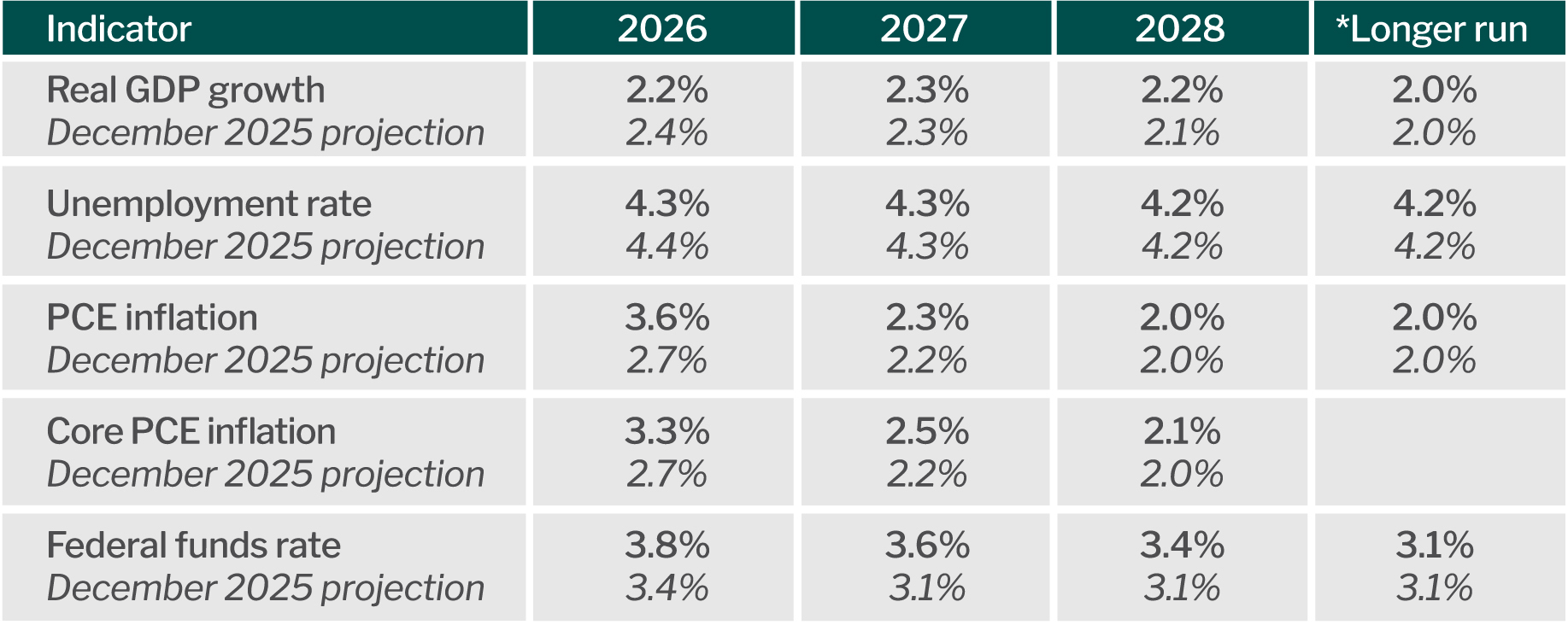
Source: Federal Reserve Board. *Longer run projections for core-PCE are not collected.
The 2-year Treasury yield is expected to fluctuate in a range of 4.00-4.50% for the next couple of months while 10-year Treasury yields range between 4.30-4.60%. This outlook could change dramatically due to developments in the Middle East and other risks to the outlook.
Employment
May’s labor market was stronger than expected. Unemployment was unchanged at 4.3%, while nonfarm payrolls rose 172,000, which exceeded market expectations for an increase of 88,000. Revisions to the prior two months’ reports resulted in an increase of 93,000. Payrolls have increased by more than 170,000 for three straight months. Some of the increase is related to the U.S. hosting the World Cup, which may be a headwind for payrolls in July and August. Wages rose 0.3% to $37.53/hour. Compared to a year ago wages are up 3.4%
Jobs, Unemployment and Hourly Earnings 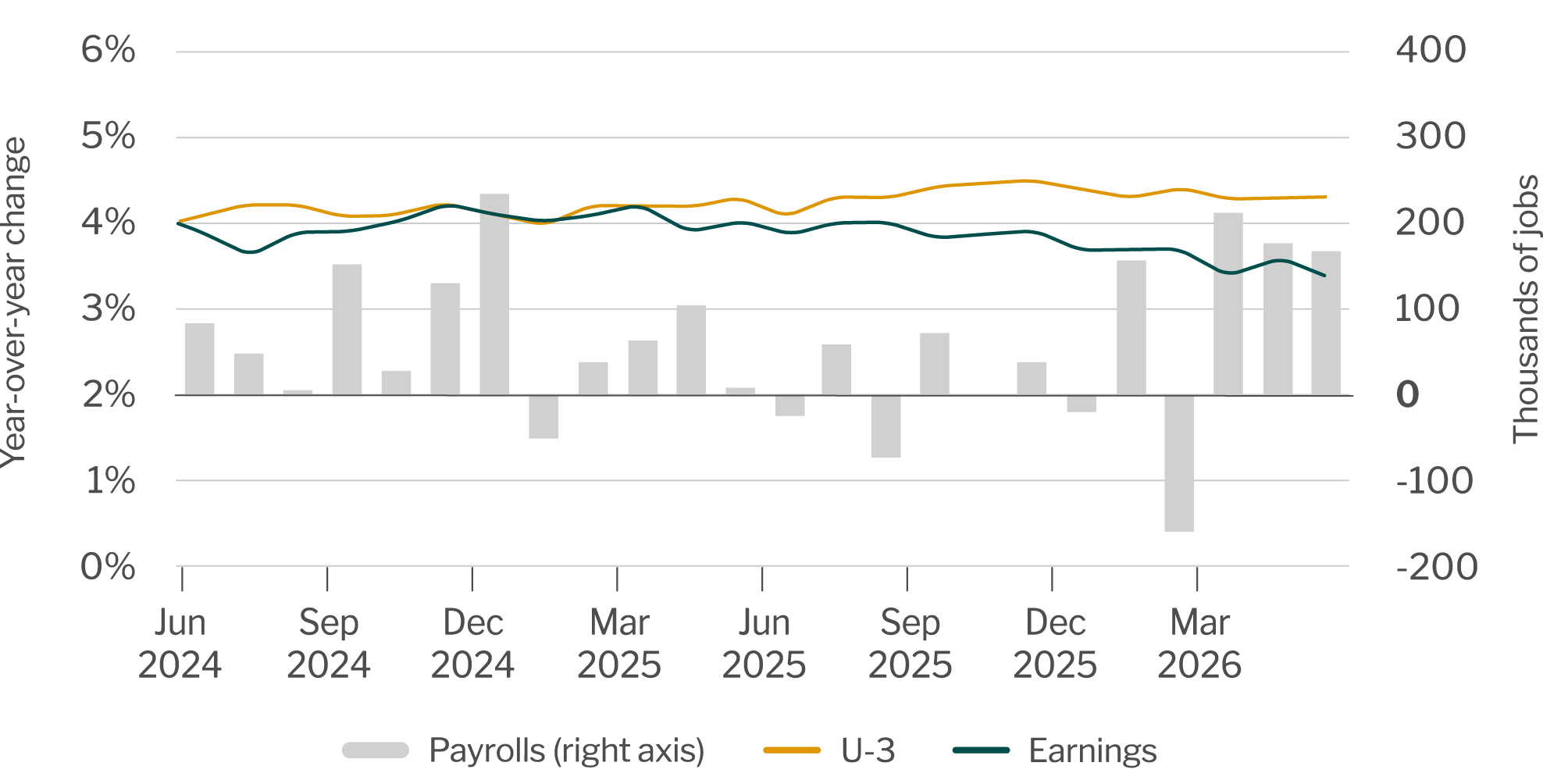
Source: U.S. Bureau of Economic Analysis.
Inflation
Key sources of inflation include:
- Oil, fuel and fertilizer prices fed through the supply chain
- Tariff pass-through and trade uncertainty
- Seasonality and services inflation
- Structural forces such as deglobalization and supply chain realignment
Housing continues to play an outsized role in inflation measures. Owners’ Equivalent Rent (OER), which captures the imputed cost of housing services, remains sticky and contributes significantly to core inflation. While the U.S. methodology for housing inflation is considered more comprehensive than those used in many other countries, it may overstate “true” inflation during periods of market adjustment.
Consumer Price Index 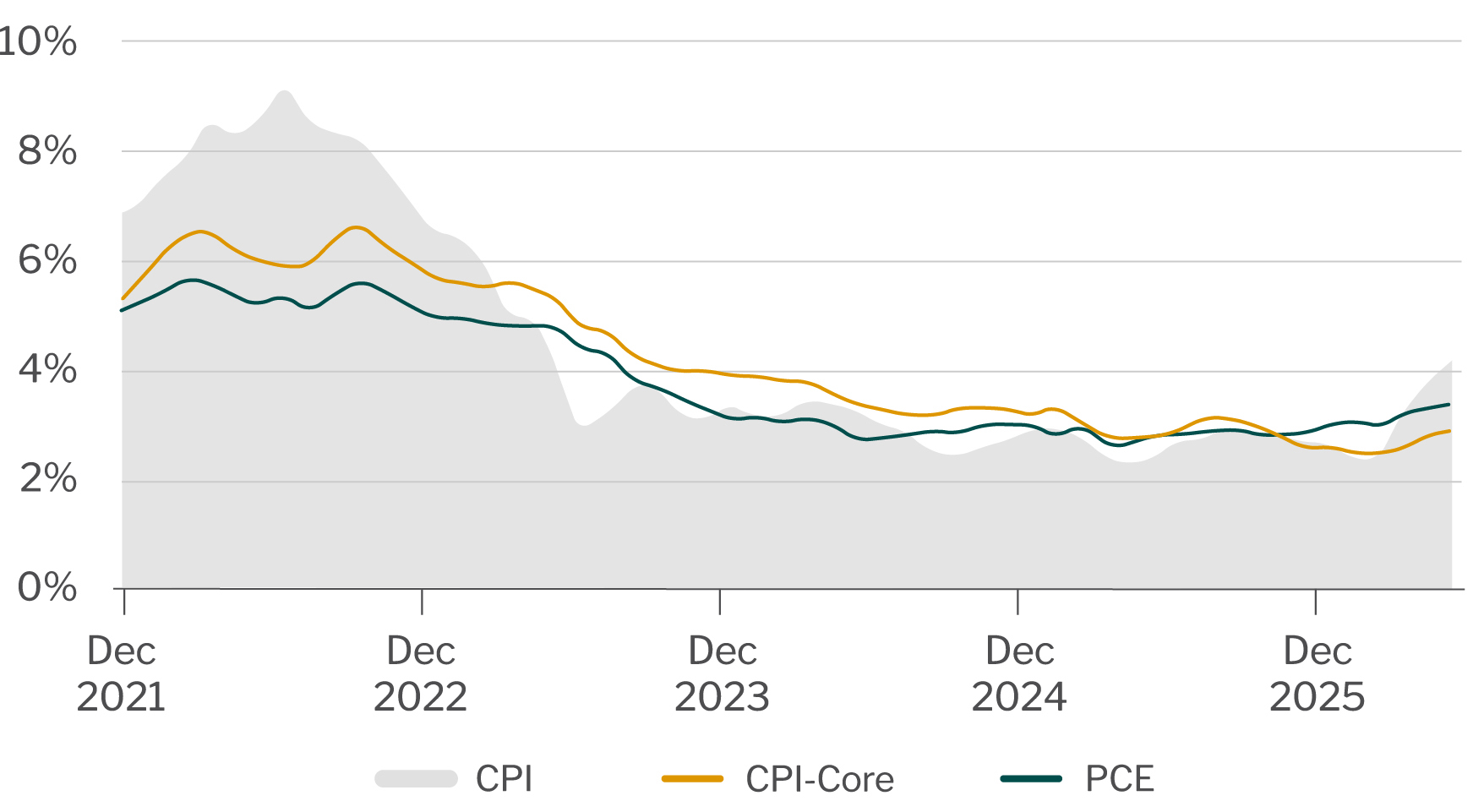
Source: U.S. Bureau of Labor Statistics. U.S. Bureau of Economic Analysis.
Gross Domestic Product
Gross Domestic Product (GDP) .jpg?sfvrsn=1709f046_1/real-gross-domestic-product-(gdp).jpg)
Source: U.S. Bureau of Economic Analysis.
Return to Industry Insights home page
IN THIS SECTION

.jpg?sfvrsn=bc72c53a_1 "My project-1 (18)")
Industry Insights
Access monthly updates on top commodities and the economy, plus special reports on profitability, land values and drought.
Learn more