 Weather
 Locations
 Careers
 Login
Login

Spotlight: U.S.–Mexico–Canada agricultural trade
The upcoming United States–Mexico–Canada Agreement (USMCA) review will determine whether North American trade stability continues or shifts toward greater uncertainty. The USMCA has direct implications for U.S. agriculture. The 2026 review is a mandatory, six-year check-in that will determine whether to extend the agreement for another 16-year term or risk its termination in 2036. It signifies the first step toward renewal or renegotiation, and sets the trajectory for long-term planning. For ag producers, the primary risk of renegotiation is not necessarily market access loss, but increased policy uncertainty, targeted disputes and stricter enforcement that could weigh on trade.
Why does USMCA matter?
USMCA’s importance reflects the scale of economic impact and regional integration. Although the U.S., Canada, and Mexico represent just 6.3% of the global population, they account for roughly 29.6% of global GDP (International Monetary Fund) and nearly 20% of global agricultural exports (World Trade Organization). This concentration underscores the region’s outsized role in global trade and U.S. farm income.
The integration of agricultural markets among the three countries is deep. Canada and Mexico account for more than one-third of U.S. agricultural exports, totaling about $29.5 billion and $30.6 billion, respectively. At the same time, the U.S. relies heavily on imports from both, with $41.0 billion from Canada and $43.9 billion from Mexico (see chart below for more details). While supply chain integration does create competitive pressure in some domestic agricultural industries, it also supports year-round availability and overall efficiency.
Agricultural exports between the U.S., Mexico and Canada, in USD
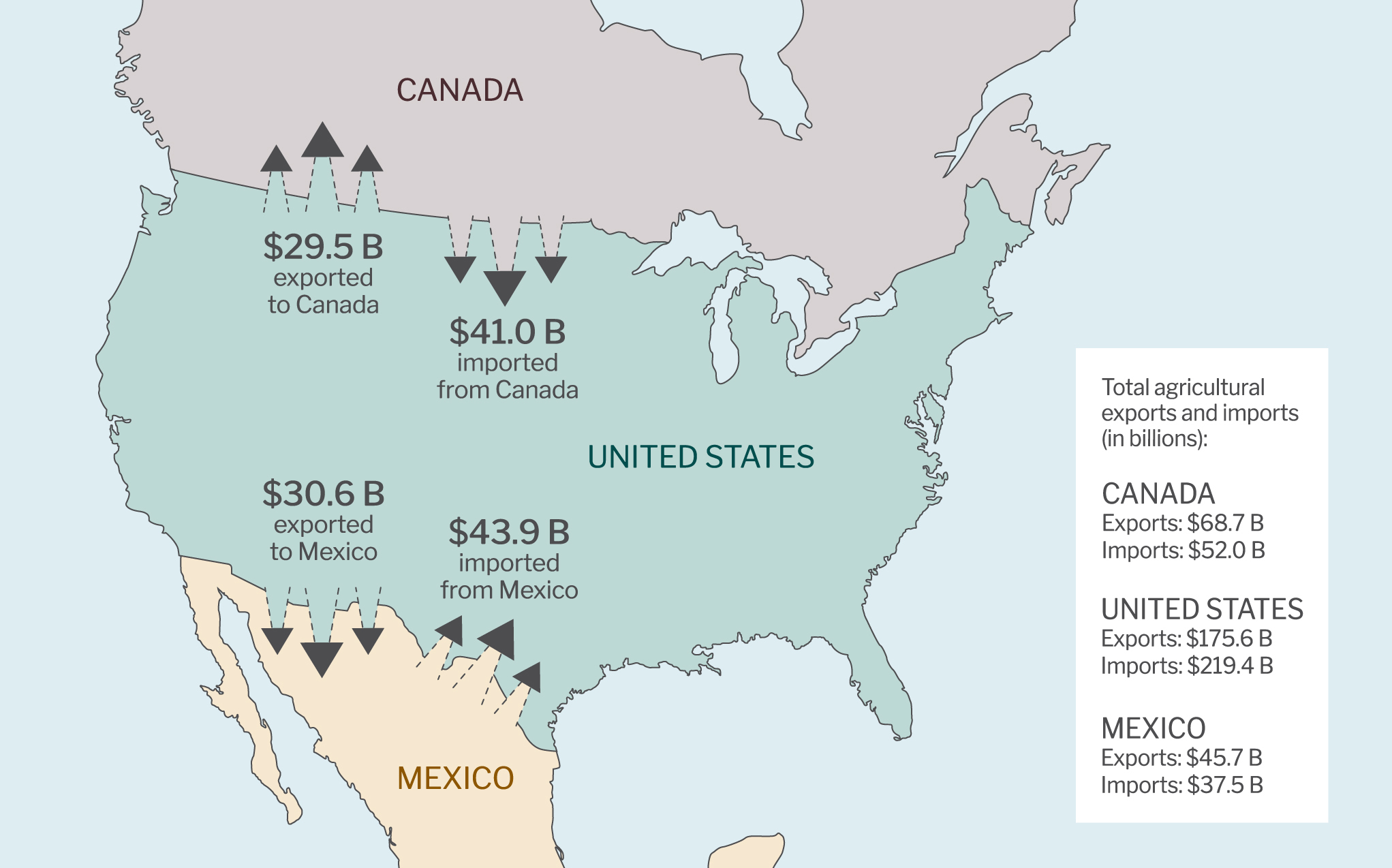
Source: USDA ERS, WorldBank.
Note: Minor discrepancies exist across countries due to differences in how agricultural products are defined and classified
What can be expected from this review?
Maintaining stable market access will be critical to U.S. agricultural competitiveness. Recent discussions have raised potential concerns around fruit and vegetable trade with Mexico and dairy provisions with Canada. While these issues may surface, the broader priority will likely be preserving the integrated trade framework. The outcome will directly shape trade relationships, investment decisions, and economic conditions across North American agriculture.
Return to Industry Insights home page
IN THIS SECTION

.jpg?sfvrsn=68087301_1 "My project-1 (26)")
Economic headlines, data and trends
Monthly economic trends, data and major industry headlines.
Learn more