 Weather
 Locations
 Careers
 Login
Login

Fertilizer prices
October 8, 2025
by
AgWest Farm Credit
The agriculture sector is grappling with the persistent challenge of fertilizer price volatility. While prices have not returned to the record highs of 2022, they remain elevated and unpredictable. For farmers, these dynamics are squeezing already tight margins, making strategic planning and cost management more critical than ever.
Fertilizer Prices
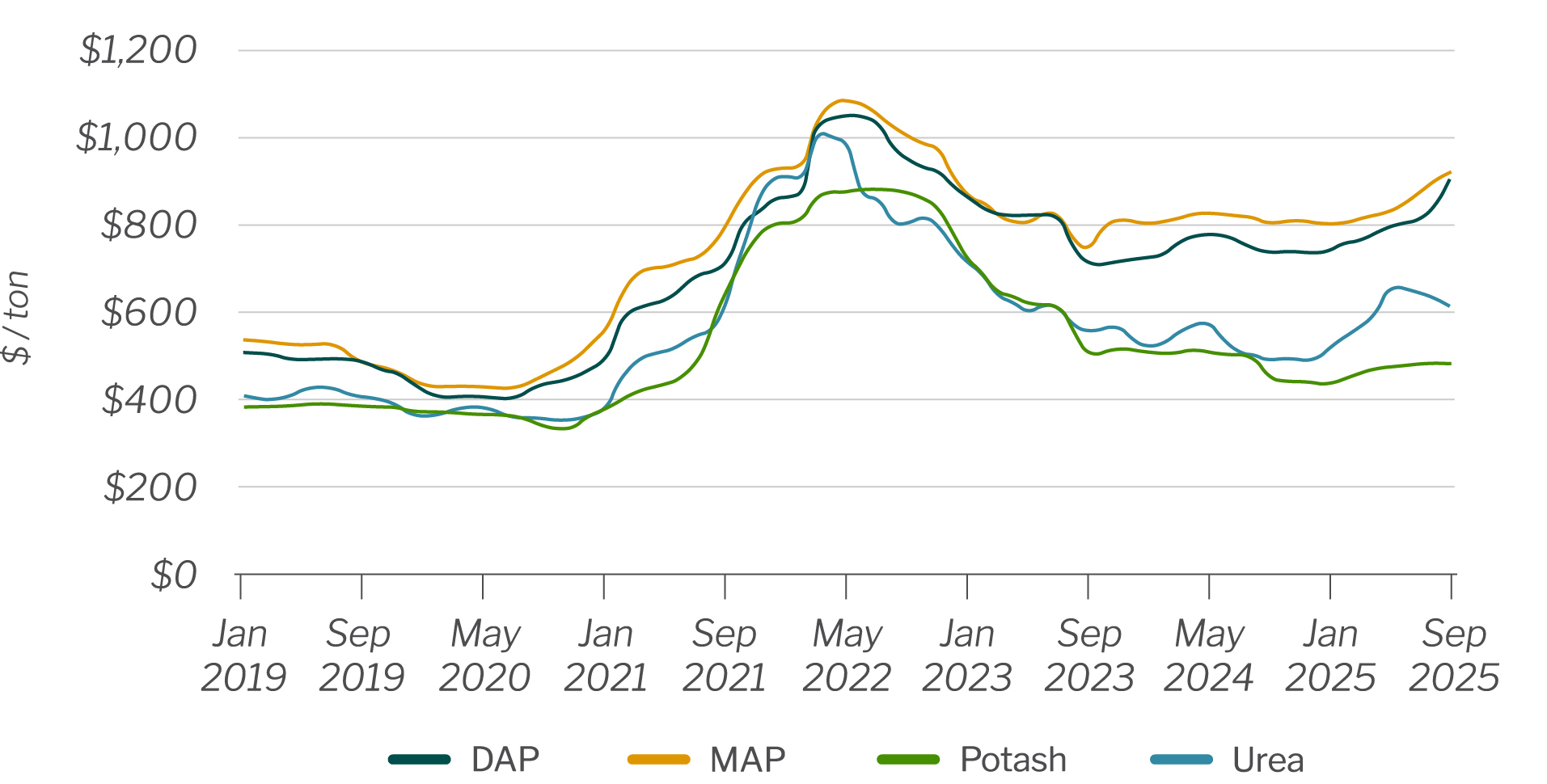
Source: DTN Progressive Farmer Prices.
What’s driving fertilizer prices?
- Geopolitical tensions and trade policies – The U.S., as a net importer of fertilizer, produces less than 9% of the global supply while importing 11%. Notably, 95% of the potash consumed in the U.S. is imported, with the majority sourced from Canada. However, a 10% tariff on Canadian potash has further driven up domestic prices. China, one of the world’s leading exporters of phosphate and urea, has implemented inconsistent export policies. This has tightened international supply and challenged U.S. buyers who rely on steady imports. Additionally, urea prices are being impacted by increased demand from India, which has been purchasing large quantities in response to favorable rainfall during the 2025 monsoon season. The ongoing Iran-Israel tensions has led to fertilizer and natural gas (the primary ingredient for nitrogen-based fertilizers) production shut-downs in Iran and Egypt, exacerbating global supply shortages.
- Transportation challenges – The Mississippi River plays a vital role in moving fertilizer from production and import hubs near the Gulf to farms up the river. Low water levels in 2025 have reduced its throughput capacity and incentivized suppliers to utilize rail and trucking, which are significantly more time consuming and expensive modes of transportation.
- Energy market fluctuations – Natural gas, a key input for nitrogen fertilizers, remains a critical cost driver. Seasonal demand spikes, rising energy demand from data centers, and disruptions due to wars in Europe and the Middle East, are significant market drivers. Rising natural gas prices in the U.S. and Europe are pushing up production costs for ammonia, urea, and UAN (urea ammonium nitrate).
Impact on producers
The fertilizer outlook for 2026 remains challenging. According to USDA, fertilizers typically account for about 13% of total production costs but can rise to as much as 24%, depending on the commodity. Actively managing fertilizer decisions will be crucial to controlling expenses. To navigate rising fertilizer prices, producers might adopt strategies to optimize fertilizer use. Precision agriculture tools, such as soil testing and variable rate application, can enhance nutrient efficiency and reduce waste. Monitoring market trends and maintaining flexibility in planting and input decisions are also critical. Cost-effective substitutions, like anhydrous ammonia over urea, and practices such as delaying or splitting nitrogen applications, can further improve efficiency and minimize losses.
Return to Industry Insights home page
IN THIS SECTION

.jpg?sfvrsn=68087301_1 "My project-1 (26)")
Economic headlines, data and trends
Monthly economic trends, data and major industry headlines.
Learn more