 Weather
 Locations
 Careers
 Login
Login

Land values - August 2026
Executive summary
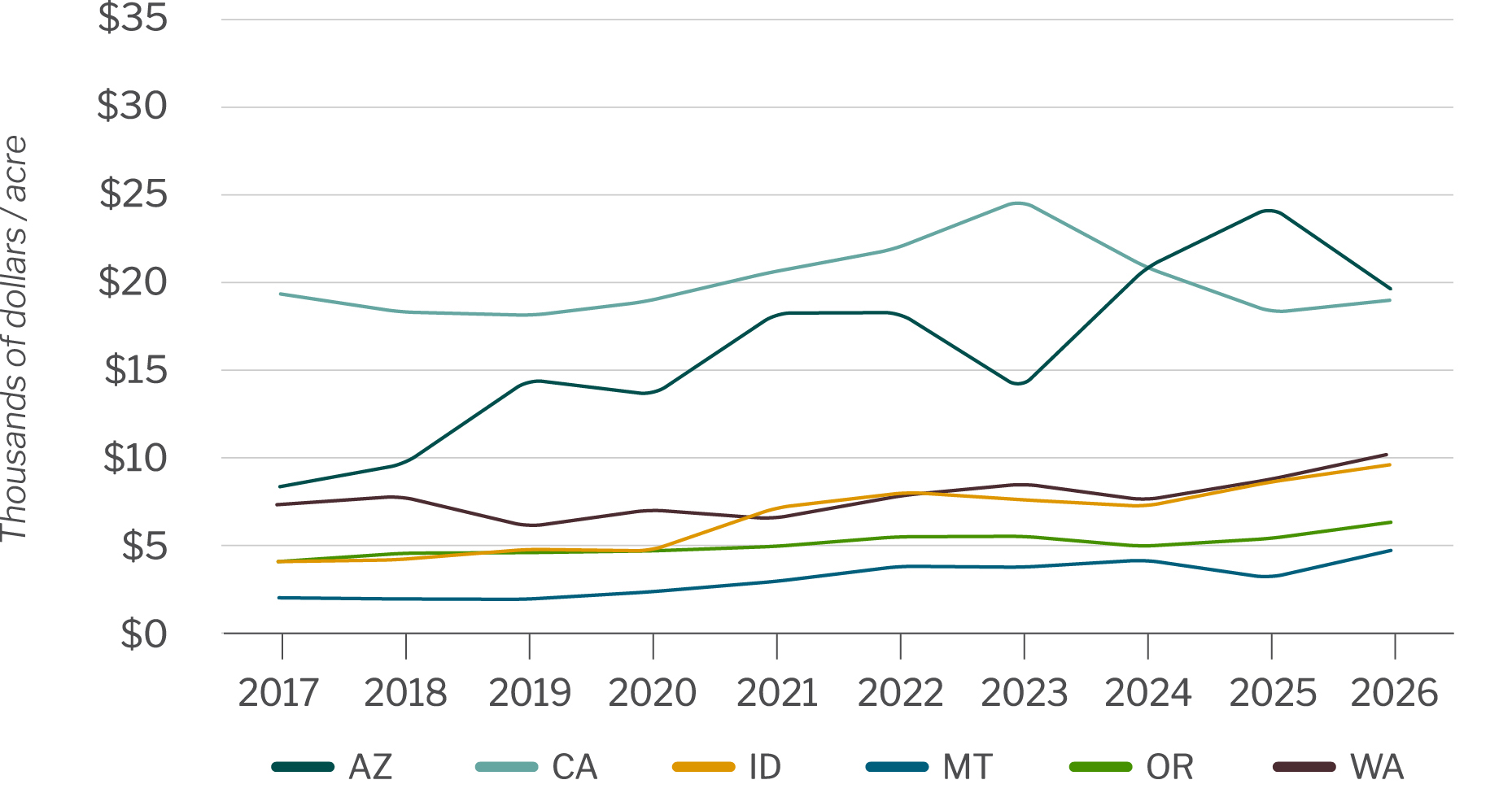
- California - Water supply constraints, combined with depressed prices for fruit and nut commodities—including table grapes, wine grapes, almonds and walnuts—resulted in value declines for agricultural properties in recent years. However, market data suggests that values may have bottomed out, supported by greater clarity on water supply outlook and strengthening tree nut pricing.
- Washington - Declining commodity prices have softened buyer demand across several permanent plantings, placing downward pressure on land values. As a result, many properties—particularly hops, uncontracted wine grapes, and apple orchards in central Washington—are experiencing extended marketing periods and weakening values.
Average land values, thousands of dollars per acre
.jpg?sfvrsn=f1845159_1)
Source: AgWest’s proprietary sales database. Industrial, commercial, residential and site sales excluded. Data in the box and whisker plot represents a 12-month rolling average. Data collection lags about six months and is subject to change. Recent changes in methodology have led to slight changes in values from the previous Land Values Report.
Land value considerations
- Interest rates – Relatively high interest rates are a frequently reported deterrent to land acquisition. More instances of creative financing, such as owner-carried notes, are reported.
- Rural residential/recreational – Most rural residential and recreational markets continue to cool, largely due to elevated interest rates. Recreational buyers are becoming more selective, seeking properties with proven amenities. Longer listing times are becoming more common and prices appear to be stabilizing.
- Availability – Inventories of agricultural land are low in much of AgWest’s territory, which continues to bolster values despite elevated interest rates. A notable exception to this trend is in portions of California and central Washington, where broker reports and AgWest’s internal market data indicate supply is outpacing demand.
- Farm income/commodity prices – The relationship between land values and commodity prices in recent years has been weak as many perceive land as a stable, long-term investment. However, this relationship is strengthening in areas such as central Washington and California’s Central Valley as poor pricing in certain markets has impacted land values. Visit our Industry Insights webpage for industry specific updates.
- Drought – As of mid-2026, drought conditions have returned to much of AgWest’s territory, particularly in southern Idaho and southwestern Montana. Winter snowpack was quite light across the territory, leading to irrigation water supply concerns in many areas. Continued extreme drought in the Colorado River Basin creates uncertainty around long-term water supplies for agriculture in Arizona, while California enjoys more senior rights.
Arizona
- Agricultural cropland prices are stable in the greater Yuma area, while sales activity is slowing, largely due to elevated interest rates. Inventory is considered adequate for current demand. Farmers are not actively seeking land to purchase, but they may purchase neighboring parcels or those that fit well into their operation when offered for sale. Investor activity is slower than in recent years due to water supply concerns and elevated interest rates.
- Cropland values in southeast and central Arizona remain stable, with overall light market activity. Inventory is considered adequate for current demand. Demand and values are strongest in areas with secure water supply and/or high development potential. Agricultural land surrounding the Phoenix Metropolitan Area is often purchased by investors due to strong population growth and interest in renewable energy projects. Investor activity is stable, although long-term water supply issues and elevated interest rates create some concern.
- Drought and poor Colorado River conditions in recent years have led to sharply reduced Central Arizona Project (CAP) deliveries, increasing irrigation costs and creating more dependence upon groundwater.
- Declining groundwater levels and expanding groundwater regulations may exert some negative pressure on agricultural land values in rural Arizona, particularly in Cochise and Graham counties. However, current data indicates stable values.
- Sales activity for dairy properties is slow. Extended listing periods are a possible indication of a softening market. Limited recent data indicates that values and lease rates are stable.
- Most participants in the pecan industry expect the market for average to good quality orchards to remain stable; however, low pecan prices in 2023-’24, higher interest rates, and volatility in the California tree nut industry slowed sales activity. While pecan prices rebounded in 2025, the unknown sustainability of a long-term water supply is a concern. Limited listings indicate soft demand.
- Pistachio orchards are rarely offered for sale due to high profitability and ownership concentration in the industry, keeping pistachio orchard values relatively high, though the unknown sustainability of a long-term water supply is a concern.
California
- Access to water is the primary driver of agricultural land values in the southern San Joaquin Valley, with buyers preferring properties with access to multiple sources of water. Secondary drivers impacting land values include interest rates and commodity prices.
- The unfolding implementation of the Sustainable Groundwater Management Act (SGMA) and related pumping restrictions have led to decreases in underlying land value across much of the southern San Joaquin Valley, particularly in those areas which lack access to surface water deliveries and/or don’t have a regulatory plan approved by the state. Court rulings and new analyses of sustainability plans have provided greater clarity around future water restrictions in recent months. This should help to reduce uncertainty for landowners and prospective buyers.
- Contributory values of permanent plantings such as almonds, table grapes and walnuts have declined across the Central Valley due to oversupply in recent years, although there is some indication that nut orchard values have stabilized as commodity prices have somewhat recovered. Contributory values among pistachio and citrus orchards remain relatively strong. Market participants appear to believe the bottom has been reached and are entering the market and making offers near listing prices.
- Demand for dairy facilities in the San Joaquin Valley is decreasing due to very thin margins. The buyer pool is limited and prefers newer, more efficient facilities that minimize costs. Less efficient facilities are typically redeveloped into feed cropland or used as heifer facilities after purchase.
- Listing times are stable to slightly increasing in the San Joaquin Valley as supply slightly outpaces demand, while listing times remain stable in the Sacramento Valley with balanced inventory.
- Land values in the Sacramento Valley have mostly stabilized following gains in tree nut prices over the last year. Cling peach orchard values are currently stable, although the recent bankruptcy of a large processor may reduce demand for fruit in the near future. Prune orchard values remain mostly stable. Rice ground values are stronger in areas where surface water supplies are more reliable.
- Premium wine grape vineyards on the Central Coast are seeing reduced demand and declining values due to a persistent lack of wine demand. Vineyards located in western Paso Robles show some resilience due to their storied heritage and being located outside of the Paso Robles Groundwater Basin; however, there is evidence of decline in this region as well.
- The supply of irrigated cropland capable of vegetable and strawberry production on the Central Coast is very limited and in high demand, particularly in the Santa Maria Valley, which benefits from high quality soils and a relatively stable long-term water supply.
- Rangeland values are stable. Properties are usually marketed directly to a well-known buyer/lessee pool and typically sell quickly, keeping values elevated.
- Imperial Valley land values are stable to slightly decreasing while rents are stable, albeit with downward pressure. Market activity is slower due to high interest rates, decreased commodity prices and trade disputes. This region has historically appealed to investors seeking water security, although this trend has dissipated in recent years, and local growers and operators now make up most of the market participation.
Idaho
- Agricultural land values in Idaho remain stable to slightly increasing when compared with previous years despite depressed prices among crops such as potatoes, onions, beets and other crops commonly grown in the area. Demand for good quality agricultural ground continues to exceed supply. Listing times are generally stable.
- The rural residential market is stable, with limited supply creating upward pressure on values and elevated interest rates creating downward pressure on values. Listing times are increasing as a result, but properties still sell in a reasonable timeframe.
- Activity in the recreational market has slowed and properties are seeing longer listing times. Prices in this sector are difficult to track as there is relatively little data, though the available data indicates stable values. Relatively high interest rates have pushed some prospective buyers out of the market, but demand is still evident.
- Despite previous agreements to avoid curtailments in 2024 and 2025, statewide drought and reduced runoff forced Idaho’s Department of Water Resources to issue a curtailment order in May 2026 for groundwater rights in the Eastern Snake Plain Aquifer that are junior to October 11, 1900 and not covered by an approved mitigation plan.
- Some irrigation companies have reduced delivery to users, and some indicate they will not have an adequate water supply to fill irrigation demands through the entire growing season.
- The Upper Snake River system is at 60% of capacity as of early June 2026 per USBR, which is below average. Surface water users may face a shortage of up to 181,600 acre-feet, forcing irrigation districts to focus on conservation once more. While these water supply concerns have the potential to adversely affect agricultural land values, the precise impact cannot be measured at this time.
Montana
- Agricultural land sales indicate values are generally stable to slightly increasing throughout the state, with higher quality production properties being limited in inventory.
- Good-quality agricultural land and cattle ranching properties continue to be in high demand. High beef prices are putting some cattle ranchers in a position to expand, supporting higher grazing land values, although there is some concern about increased operating costs due to drought. Currently, lower grain prices do not appear to have a measurable impact on land values. Limited supply has reduced overall activity. Demand for lower-quality agricultural properties has softened slightly, with longer listing times reported.
- Production agriculture still drives land values in many parts of the state, with many transactions taking place privately between landlords and tenants or between neighbors.
- Rural residential demand softened from the highs seen during COVID-19 but remains stable. However, high prices, limited inventory and elevated interest rates are precluding many would-be buyers, leading to reduced activity overall. Listing times are increasing.
- Recreational interest is strong, especially among those properties that offer amenities such as live water and fishing, direct access to public land, privacy, access to elk and bird populations, etc. Buyers are reportedly being more selective and seeking proven hunting ground, although the inventory of these properties is limited.
- Many large recreational ranch transactions are taking place off-market as demand remains extremely strong.
- A weak snowpack and warm winter of 2026 led to early runoff and anticipation of decreased summer streamflow, although large rainstorms in late May and early June mitigated drought concerns to some extent. There is some concern about water shortages during the latter part of the irrigation season.
Oregon
- Despite low commodity prices, agricultural land values are generally stable due to a limited supply of high-quality cropland. Lower quality agricultural properties show some evidence of softening prices and increasing listing times.
- Although demand continues to be strong for most property types, particularly from large operators, buyers are generally careful to ensure properties fit well into their existing operations. Investor and out-of-area buyer interest has declined slightly from the previous two years across most of the state.
- Sales activity has picked up slightly for vineyards in the Willamette Valley. Sellers are largely made up of distressed businesses, owners looking to retire and private equity firms looking to offload holdings. Transaction values are down as there are more sellers than buyers.
- Demand for rural residential properties varies depending on location. A lack of inventory is generally keeping supply below demand, propping up values. However, prices have leveled off from previous highs due to persistently elevated interest rates. Longer listing times are common. There is limited activity in the recreational market, but available data indicates strong demand.
- The number of large (5,000+ acres) timberland transactions across the Pacific Northwest has been limited the past 12 months. Log prices are stable to trending upward, and demand remains strong for high quality timber assets. Buyers are primarily local operators and investment organizations. Overall, values are perceived as stagnant to slightly increasing, but at a slower rate compared to prior years. There continues to be an active market for smaller woodland investment tracts at stable pricing.
- Drought conditions and irrigation water supply concerns re-emerged across the state in 2026. Precipitation from October 2025 through June 2026 ranged from approximately 79% to 108% of long-term averages. However, April 1 snowpack—typically the seasonal peak—was significantly below normal statewide, ranging from as low as 2% in the Blue Mountains to approximately 67% in the Coastal Range.
- Some localized areas around Burns, Redmond and Klamath Falls are experiencing irrigation water issues due to historic drought and declining water table issues, alongside other environmental concerns.
- Catastrophic wildfires in multiple areas of Oregon during 2024 and currently in 2026 have resulted in widespread operational challenges over the next several years for affected producers and will likely impact availability of grass/pasture leases.
Washington
- Irrigated and dry cropland values are holding stable throughout the state, although weak commodity markets are exerting some downward pressure. Many permanent planting properties, particularly hops, wine grape vineyards and apple orchards in central Washington, are seeing longer listing times and significant declines in contributory values.
- Demand for orchards has softened as supply has increased in the market area. Orchards with long-term inefficiencies and out-of-date varietals are experiencing the largest decreases in values.
- Rental rates are beginning to soften in some areas, and land values may follow if commodity prices remain depressed.
- In areas where a recreational market exists, few sales have occurred and extended listing times are common. Properties with proven amenities set the high end of the range. The buyer pool is reduced due to elevated interest rates and other affordability challenges.
- The rural residential market still shows strong values due to limited supply of desirable properties, although the buyer pool has decreased and listing times have increased.
- The number of large (5,000+ acres) timberland transactions across the Pacific Northwest has been limited the past 12 months. Log prices are stable to trending upward, and demand remains strong for high quality timber assets. Buyers are primarily local operators and investment organizations. Overall, values are perceived as stagnant to slightly increasing, but at a slower rate compared to prior years. There continues to be an active market for smaller woodland investment tracts at stable pricing.
Share your feedback! Click here to complete a two-minute survey about this report.
About AgWest Farm Credit Appraisal Services
AgWest appraisers provide appraisal services on rural properties throughout the West. The Appraisal Services team continually researches sales and tracks market data throughout Arizona, California, Idaho, Montana, Oregon and Washington. They compile the market data and analyze it using a central database.
This report provides a high-level look at trends and market characteristics and does not provide details for specific areas or land types. The report should not be used to identify the value of a specific property. This information is limited only to an analysis of trends in identified land values within the geographic area served by AgWest Farm Credit.
Learn more
For more information or to share your thoughts and opinions, contact the Business Management Center at 866.552.9193 or CustomerFeedback@AgWestFC.com.
To receive email notifications about western and global agricultural and economic perspectives, trends, programs, events, webinars and articles, visit www.AgWestFC.com/subscribe.
Return to Industry Insights home page
IN THIS SECTION

.jpg?sfvrsn=68087301_1 "My project-1 (26)")
Economic headlines, data and trends
Monthly economic trends, data and major industry headlines.
Learn more