 Weather
 Locations
 Careers
 Login
Login

Drought and water update - May 2026
Drought monitor
Drought conditions worsened across the West, largely due to warmer-than-normal temperatures dominating March and April. Northern California’s drought conditions have grown, while other states experienced dry conditions advancing from D0 and D1 conditions to D2 and D3 (see map below). For the latest on weather, see AgWest’s Weekly Weather Updates with Eric Snodgrass.
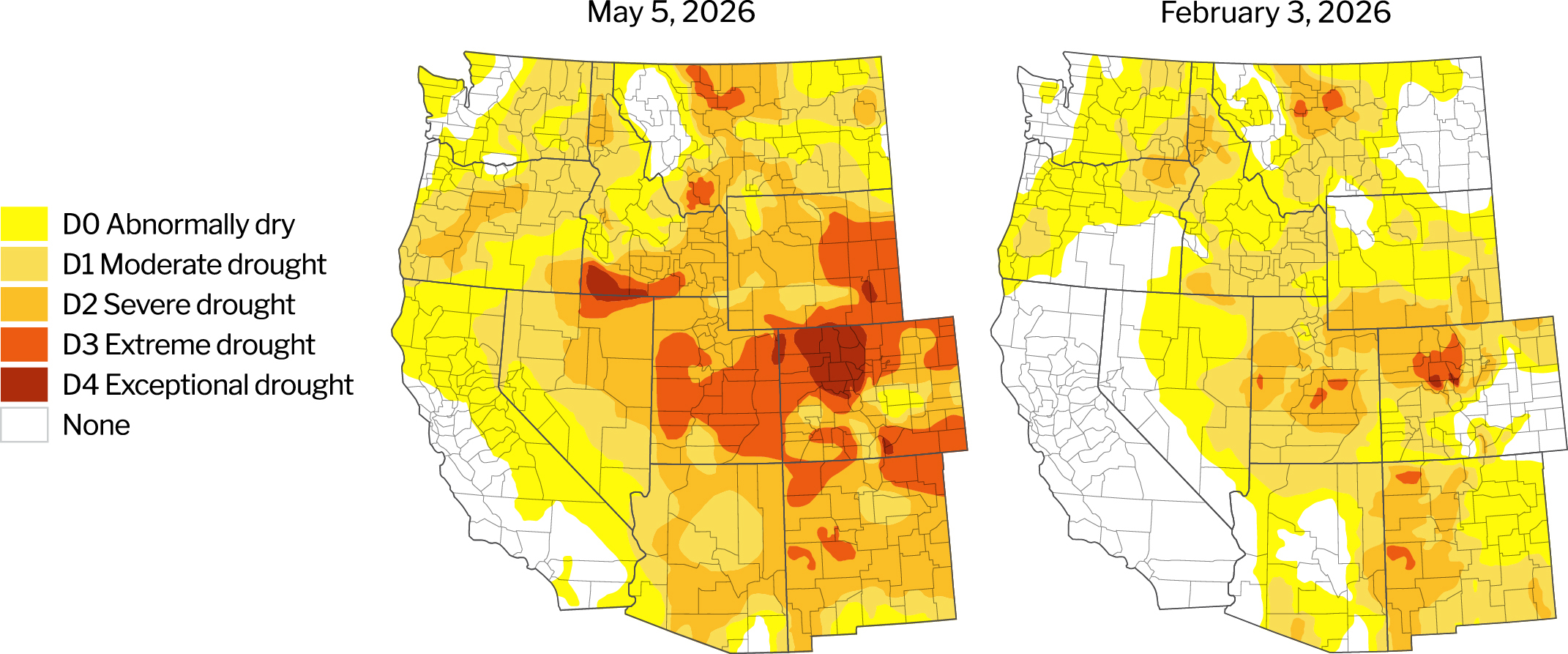
Source: U.S. Drought Monitor, University of Nebraska.
Description – The U.S. Drought Monitor provides a comprehensive look at drought conditions across the U.S., categorizing areas by intensity (no drought to exceptional drought). This tool helps agriculture producers understand water availability and make informed decisions about crop management.
Year-to-date precipitation
The West has experienced largely dry conditions throughout the winter and average spring precipitation; however, mountain snowpack is at very low levels and this may reduce water availability later in the season.
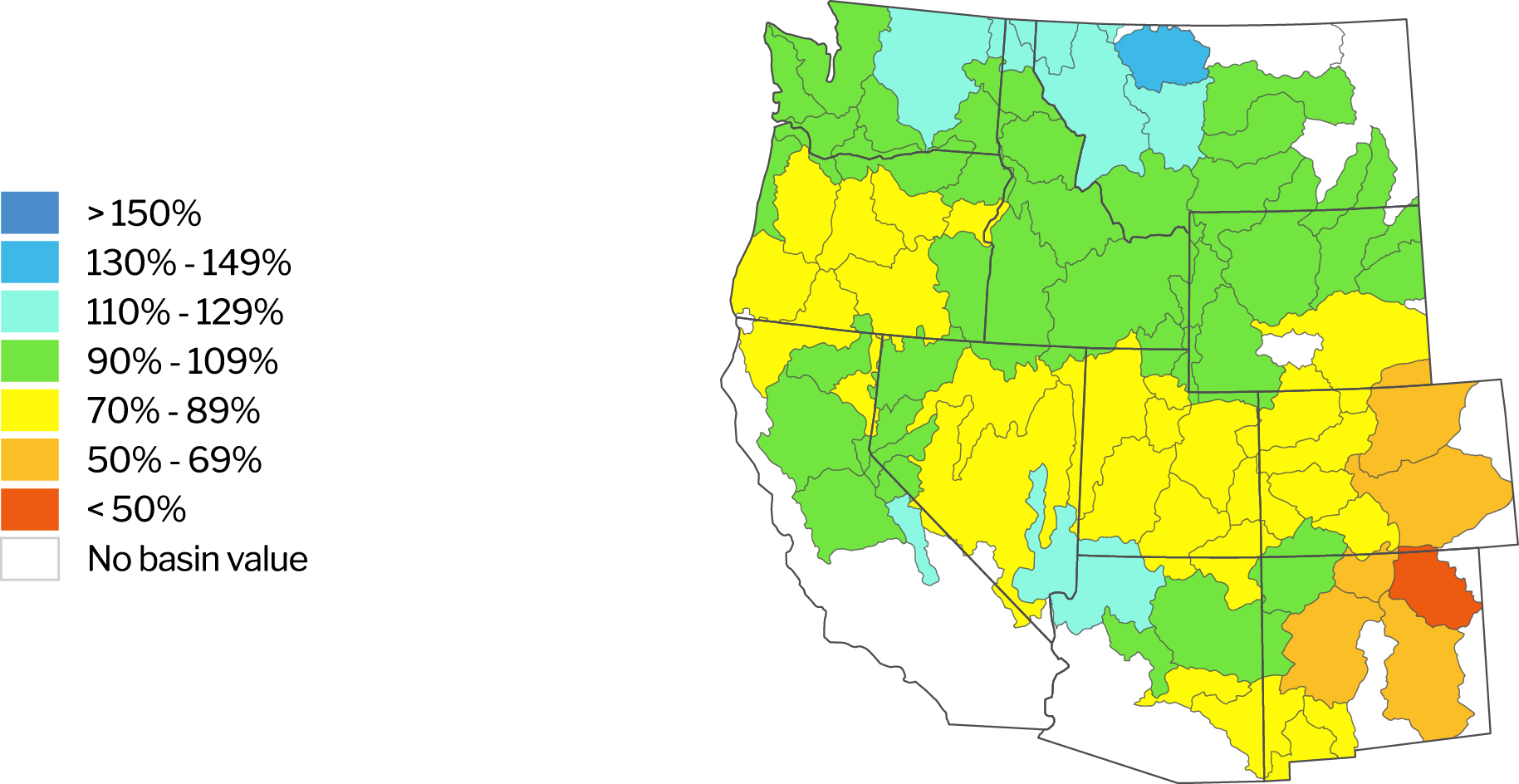
Source: Natural Resources Conservation Service. NWCC Interactive Map. Data as of May 4, 2026.
Description – The NWCC Year-to-Date Precipitation Map provides a detailed overview of precipitation levels across the U.S., comparing current data to a historical average. Similar to the Drought Monitor, this tool helps agriculture producers understand water availability and make informed decisions about crop management.
Reservoirs with low water levels
Reservoir levels have improved throughout much of the West, with those in California and Washington all at or near their historical averages. Several reservoirs in Idaho and Oregon remain notably below average. Lake Powell and Lake Mead levels remained steady, albeit at historically low levels.
Reservoirs with water levels below 80% of their historical average
| Location/Region | Reservoir | Percent of average level | Percent of previous year |
|---|---|---|---|
| Colorado River Basin | Lake Powell | 40% | 73% |
| Lake Mead | 50% | 95% | |
| Idaho | American Falls | 76% | 79% |
| Ririe | 75% | 79% | |
| Palisades | 47% | 68% | |
| Oregon | Cold Springs | 73% | 106% |
| Crescent Lake | 51% | 119% | |
| Emigrant | 79% | 71% | |
| Fourmile Lake | 42% | 47% | |
| Haystack | 63% | 68% | |
| Ochoco | 77% | 60% | |
| Prineville | 73% | 70% | |
| Hyatt | 56% | 69% | |
| Phillips | 70% | 58% |
Source: Bureau of Reclamation: Reservoir Storage. California Department of Water Resources. Arizona Department of Water Resources. Data as of May 4, 2025.
Description – Reservoirs are an important source of water for agriculture producers throughout the West. This section identifies those with water levels at 80% or below of their historical average for the given period. Reservoirs at or above 80% of their historical average water levels are not included in this list.
Updates impacting water access
Arizona
Conditions deteriorated quickly in 2026, with 87% of the state now classified in moderate (D1) or greater drought; a 53% increase over the past three months. Snow water equivalent levels remain below average following the hottest January through March period on record. Dryness persisted through April, with above-normal temperatures and minimal precipitation. Reservoir levels continue to worsen, with Lake Mead and Lake Powell well below historical averages and unlikely to see meaningful improvement in the near term. Forecasts indicate Lake Powell will receive less than one-third of normal spring inflows, reinforcing expectations that the Colorado River Basin will remain in a Tier 1 shortage. For Arizona, this translates to an approximately 30% reduction in Central Arizona Project water deliveries, or roughly 512,000 acre-feet below normal.
Uncertainty around future Colorado River management remains elevated, adding risk for long-term water access. Lower basin states (Arizona, California, and Nevada) and the upper basin states (Colorado, New Mexico, Utah, and Wyoming) failed to reach a replacement agreement by the Feb. 14 deadline, prompting federal officials to begin drafting new management options. Early drafts of the federal plan emphasize reductions tied to actual hydrologic conditions rather than fixed legal allocations, a shift that could result in larger cuts for high‑use lower basin states such as Arizona and California during drought years. Lower Basin states have proposed a separate plan to reduce allocations by 20% through 2028, including an additional 700,000 acre-feet of conservation. Meanwhile, Arizona has allocated $3 million for legal defense, with an additional $1 million proposed as negotiations stall and the risk of litigation grows.
Within the state, a recent court ruling could ease regulatory pressure on agricultural water users by reinforcing limits on how state agencies implement groundwater restrictions. A Maricopa County judge struck down the Arizona Department of Water Resources’ “unmet demand” rule, which had broadly restricted access to groundwater based on projected shortages primarily in the Phoenix area. For agricultural producers, the decision reinforces that water availability determinations must follow established legal processes and cannot be expanded through new interpretations without formal rulemaking.
California
California has shifted from drought-free to 60% of the state classified as abnormally dry over the past three months. Snow water equivalent levels are significantly below average across the northern half of the state. Low snowpack could negatively affect water availability and reservoir recharge later in the season.
The Department of Water Resources (DWR) found that the Phillips Station, a critical snow indicator, recorded no measurable snow in April. Record warm March conditions, combined with early atmospheric river events in February, melted snowpack in the Sierra Nevada months ahead of schedule. While reservoir storage levels are currently above average, this early runoff could create challenges for water supply later in the season. As of May 7, statewide snowpack measured just 22% of normal. In the Northern Sierra Nevada, home to many of the state’s largest reservoirs, snowpack is just 6% of average. In response to growing concerns over weather conditions and water management, DWR has expanded its monitoring efforts, including the addition of a mid-month snow survey.
The Bureau of Reclamation announced updates to the Central Valley Project (CVP) allocations that will modestly increase water deliveries for some users. Water allocations for Cross Valley and south‑of‑Delta agricultural contractors were raised from 15% to 20% of their contracted supply. In addition, south‑of‑Delta users will have access to about 220,000 acre‑feet of additional water, roughly a 10% increase, that had previously been rescheduled for later use.
The U.S. Department of the Interior announced $540 million in federal funding for water infrastructure upgrades across California. The funding includes $235 million for repairs to the Delta‑Mendota Canal and $200 million to address subsidence along the Friant‑Kern Canal. Additional investments include $50 million for improvements to the San Luis Canal and $15 million for the Tehama‑Colusa Canal to increase flow rates and system performance. Shasta Dam will receive $40 million to support planning and early construction activities for raising the dam; a project expected to increase water storage capacity by approximately 634,000 acre‑feet.
The Friant Water Authority and the Eastern Tule Groundwater Sustainability Agency (GSA) reached a court settlement resolving a dispute over damage to the Friant‑Kern Canal, of which a 33-mile stretch sank due to excessive groundwater pumping. The settlement replaces the prior agreement with new pumping penalties to help fund canal repairs, eliminates Eastern Tule’s groundwater allocations for the 2026 water year, and directs all collected penalties to Friant.
The city of Arroyo Grande will ask voters in November to approve changes allowing the city to buy state water outside of drought emergencies. Currently, Arroyo Grande is only authorized to buy state water during emergencies, which limits planning flexibility. City officials say the proposed change would not mandate immediate water purchases but would provide an option to secure additional supplies if needed.
The State Water Resources Control Board considered and ultimately denied eight requests from Tule Subbasin groundwater sustainability agencies to exempt local producers from Sustainable Groundwater Management Act (SGMA) probation requirements under the law’s “good actor” clause, including groundwater pumping reporting and state‑imposed fees. Farmers testified that SGMA compliance and local GSA restrictions have already cost producers millions of dollars and significantly reduced access to groundwater. Despite those concerns, the Board voted unanimously to move forward with probationary sanctions, requiring groundwater reporting by May 1 and imposing fees estimated to total up to $12 million annually across the subbasin.
In contrast, similar enforcement actions in the Tulare Lake Subbasin were delayed after the Kings County Farm Bureau filed suit against the State Water Board. While the Tule decision resolves the exemption requests, it underscores rising financial and regulatory pressure on Tulare County producers as state oversight intensifies. The case is scheduled to go to court in early June, and fees tied to this report will not be collected until after the preliminary injunction is resolved.
Idaho
Drought conditions have worsened, with moderate drought (D2) now covering 46% of the state, up 35% over the past three months. Idaho experienced its second-warmest winter on record (October–March snow accumulation period), prompting the governor to issue a statewide drought emergency declaration. This declaration allows water users to apply for temporary changes to their water rights and makes the state eligible for federal drought assistance. Snowpack and snow water equivalent levels were at record lows on April 1, with most SNOTEL sites reporting historically low values.
While the season remains early, the Natural Resources Conservation Service (NRCS) indicates that irrigation shortages will be a significant challenge this year. Snowmelt is occurring several weeks ahead of schedule, prompting early reservoir releases. As a result, water that would typically arrive later in the season is being released now, increasing concerns about water availability during peak irrigation demand in August.
The Idaho Department of Water Resources (IDWR) reported that senior surface‑water users on the Snake River Plain are projected to face a record shortfall of 181,600 acre‑feet. According to IDWR, the projected deficit includes 43,900 acre‑feet owed to American Falls Reservoir District No. 2 and 137,700 acre‑feet owed to water users served by the Twin Falls Canal Co. The shortfall has placed junior groundwater pumpers at the center of ongoing water‑rights enforcement, as they must either participate in an approved mitigation plan or face shutoffs of their water rights.
The U.S. Department of the Interior announced $30 million in funding for Idaho to support improvements to the Lewiston Irrigation District’s pump‑storage project.
Montana
Drought conditions deteriorated notably over the past three months, with much of the state shifting from abnormally dry and moderate drought (D0–D1) into moderate to severe drought (D1–D2) classifications. Montana is facing its sixth consecutive year of abnormally dry spring conditions following an unusually warm winter that produced low snowpack and heightened concerns about rapid spring runoff.
Snow at elevations below 6,500 feet melted roughly one month earlier than normal, increasing the risk of early river and stream peak flows, and reduced baseflows later this summer if timely precipitation does not occur. Statewide snowpack remained below normal in April. Although recent storms boosted snow water equivalent in parts of central and western Montana, warmer temperatures quickly eroded much of these gains, leaving existing deficits largely intact. As a result, water availability later in the irrigation season remains a significant and growing concern.
Fairfield, a town of about 800 residents in north‑central Montana, is facing an escalating water shortage. This shortage has been driven by a combination of worsening drought conditions and severely aging infrastructure, with nearly two‑thirds of its water pipes dating back to 1946 and an estimated 50% of pumped water lost to leaks. Several of the town’s eight wells are already non-operational or running at partial capacity, and officials warn that additional failures could force the use of portable toilets at schools and businesses. The crisis extends beyond town residents to surrounding agricultural operations, where farmers and ranchers face reduced water availability.
Oregon
Drought conditions deteriorated moderately over the last three months with more than 70% of the state in moderate (D1) or more severe drought conditions. Snow water equivalent levels reached an all-time low and range from 0% to 46% of average on May 7, which could lead to lower water availability in the summer and increased wildfire risks.
Proposed Oregon House Bill 3419 has sparked growing concern among well drillers and agricultural producers across the state, as it would introduce new monitoring and reporting requirements for most existing wells and water systems. While the bill is framed as a resource management effort, critics argue it disproportionately targets agricultural producers who have relied on established water rights.
Data centers in The Dalles consume about 40% of the city’s total water supply, a sharp year‑over‑year increase that is fueling concern among residents as drought conditions persist and the data center footprint grows.
Washington
Drought conditions have eased slightly over the past three months, supported by late spring precipitation events, though 40% of the state remains in moderate drought (D1). Dryness concerns are increasing in Eastern and Central Washington, where snow water equivalent levels range from 23% to 60% of average. Snowpack remains well below normal due to warmer than average temperatures and limited spring precipitation, which may constrain water availability later this summer.
Washington has declared a statewide drought emergency. State leaders warned that insufficient snowpack limits natural water storage needed to sustain rivers and reservoirs through the dry season, raising the likelihood of reduced irrigation, low streamflows and heightened wildfire danger. This marks the fourth consecutive year Washington has declared a drought emergency.
Return to Industry Insights home page
IN THIS SECTION

.jpg?Status=Master&sfvrsn=68087301_1 "My project-1 (26)")
Economic headlines, data and trends
Monthly economic trends, data and major industry headlines.
Learn more