 Weather
 Locations
 Careers
 Login
Login

Drought and water update - November 2025
Drought monitor
Drought conditions have improved in the West. The number of acres under severe and extreme drought fell notably in Washington, Idaho and Arizona. Outside of the southern portion of the state, California is at/near normal conditions. Montana and Arizona continue to face moderate to extreme drought throughout a large portion of their states. For the latest on weather, please see AgWest’s Weekly Weather Updates with Eric Snodgrass.
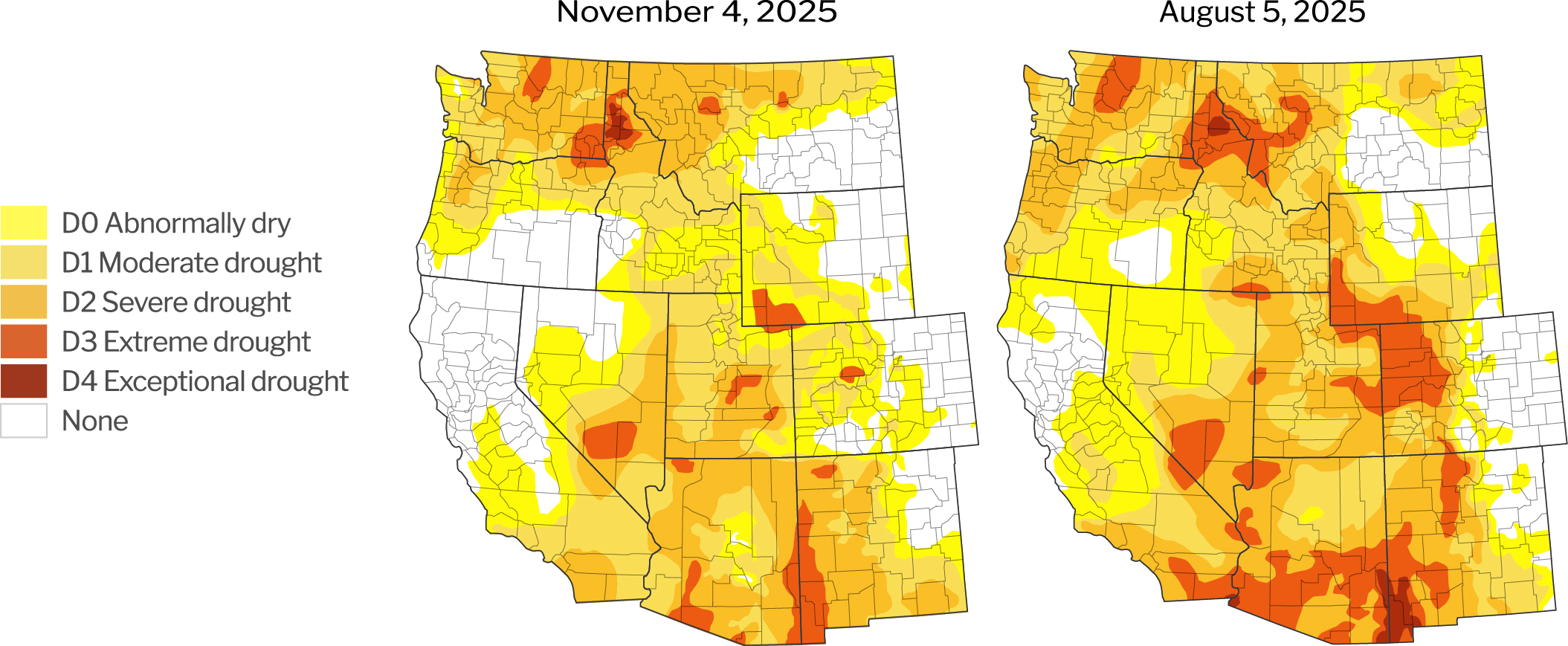
Source: U.S. Drought Monitor, University of Nebraska.
Description – The U.S. Drought Monitor provides a comprehensive look at drought conditions across the U.S., categorizing areas by intensity (no drought to exceptional drought). This tool helps agriculture producers understand water availability and make informed decisions about crop management.
Year-to-date precipitation
The West experienced strong precipitation levels at the start of fall. Water year-to-date (Oct. 1 – Nov. 4, 2025) precipitation levels exceed 100% across much of the region, with the exceptions being northcentral Oregon and northeast Montana.
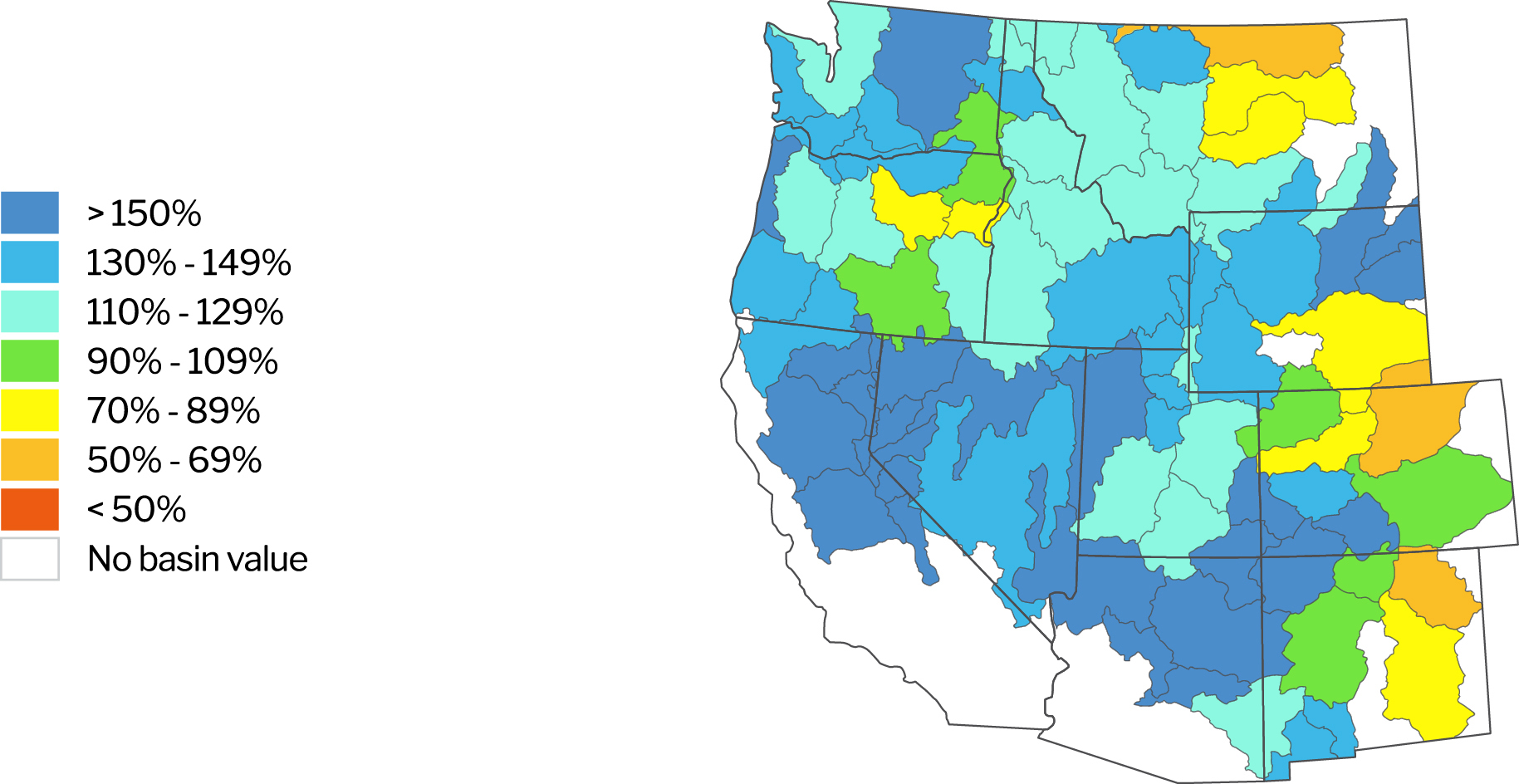
Source: Natural Resources Conservation Service. NWCC Interactive Map. Data as of November 5, 2025.
Description – The NWCC Year-to-Date Precipitation Map provides a detailed overview of precipitation levels across the U.S., comparing current data to a historical average. Similar to the Drought Monitor, this tool helps agriculture producers understand water availability and make informed decisions about crop management.
Reservoirs with low water levels
Water storage levels across much of the West worsened over the last three months, particularly in Idaho, Washington and Lake Powell. Despite challenges, precipitation levels have improved over the last several weeks, and this is improving conditions heading into winter.
Reservoirs with water levels below 80% of their historical average
| Location/Region | Reservoir | Percent of average level | Percent of previous year |
|---|---|---|---|
| Colorado River Basin | Lake Powell | 44% | 75% |
| Lake Mead | 52% | 97% | |
| Idaho | American Falls | 57% | 71% |
| Island Park | 79% | 74% | |
| Lake Walcott | 69% | 38% | |
| Little Wood | 66% | 74% | |
| Mann Creek | 44% | 339% | |
| Palisades | 25% | 28% | |
| Reservoir A | 77% | 100% | |
| Soldiers Meadow | 68% | 74% | |
| Oregon | Crescent Lake | 43% | 193% |
| Fourmile Lake | 31% | 79% | |
| McKay | 62% | 73% | |
| Scoggins | 62% | 69% | |
| Thief Valley | 67% | 170% | |
| Washington | Bumping | 76% | 214% |
| Cle Elum | 26% | 180% | |
| Kachess | 30% | 88% | |
| Keechelus | 41% | 180% | |
| Rimrock | 50% | 190% |
Data as of November 5, 2025.
Source: Bureau of Reclamation: Reservoir Storage. California Department of Water Resources. Arizona Department of Water Resources.
Description – Reservoirs are an important source of water for agriculture producers throughout the West. This section identifies those with water levels at 80% or below of their historical average for the given period. Reservoirs at or above 80% of their historical average water levels are not included in this list.
Updates impacting water access
United States
A federal judge in California paused the Trump Administration’s plan to lay off more than 2,000 people in the Department of Interior (DOI). The prospect of layoffs would come as funding freezes to activities under the Inflation Reduction Act were already impacting various water conservation efforts and infrastructure projects across the West.
Arizona
Drought conditions improved notably over the last month; however, nearly all of Arizona remains in drought ranging from moderate to extreme. Lakes Powell and Mead are well below their historical averages, with Powell significantly down from this time last year. The U.S. Bureau of Reclamation’s (USBR) latest hydrology report, published every two years, was released in August 2025 and suggests water allocations for the Lower Basin states will continue under the Tier 1 shortage conditions in 2026. Arizona may again experience an 18% cut from its normal allotment.
Colorado River Compact negotiations remain tense and ongoing between lower basin states (Arizona, California and Nevada) and upper basin states (Colorado, New Mexico, Utah and Wyoming). Operating guidelines for the river established in 2007 are set to expire in 2026. At the writing of this report, an agreement has yet to be reached, and this may result in the USBR stepping in.
Efforts by the Arizona Farm and Ranch Group Coalition to challenge Attorney General Kris Mayes’ suit against a Saudi owned alfalfa farm for excessive pumping was thwarted in court. A judge ruled that ranchers and cities do not have the right to intervene in this suit. Meanwhile, La Paz County Supervisor Holly Irwin is pushing to create an Active Management Area (AMA) in the same basin. An AMA could limit pumping but grandfather existing uses.
California
Much of California is out of drought; however, conditions remain difficult in the southern portion of the state, which is largely in severe drought. Reservoir levels in California are at or above their historical averages heading into winter. Depending on precipitation levels over the coming months, dam operators will need to continue balancing water supply needs with flood control measures.
An appellate court ruled that California can enforce the Sustainable Groundwater Management Act (SGMA), reversing a lower court’s injunction that had blocked state sanctions in Kings County. The decision affirms the State Water Resources Control Board’s authority to regulate groundwater use, including requiring water meters and imposing extraction fees. The ruling allows the state to continue enforcement while the case proceeds to trial.
The South Fork Kings Groundwater Sustainability Agency (GSA) approved a draft pumping allocation policy, which is currently under a mandatory public comment period. The proposed policy sets sustainable yield at 0.66 acre-feet per acre and phases out transitional pumping to zero by 2040 to comply with SGMA. Transitional allocations decrease in five-year blocks across three aquifer zones, with over pumping penalized at $500 per acre-foot plus future cuts. Sustainable yield can be traded outside the GSA with strict limits, while transitional water cannot.
Kaweah subbasin water managers announced the region will likely avoid state intervention as the Water Resources Control Board recommended returning oversight to the Department of Water Resources, with a vote set for Dec. 2. Despite the reprieve, GSAs must work to cut 120,000 acre-feet in pumping via allocations. Managers emphasized rapid action on subsidence, water quality, and domestic wells, urging growers to register wells by mid-2026, improve efficiency, and recharge excess water collectively.
The Kern Fan Groundwater Storage Project secured an additional $22 million in Proposition 1 funding, bringing its total to $111 million. The joint Rosedale-Rio Bravo and Irvine Ranch effort, set for 2030 completion, will store up to 100,000 acre-feet in wet years across 1,300 acres of recharge ponds, with 25% reserved for Delta fish pulse flow during low water years.
The Kern subbasin was taken off of the Water Resources Control Board’s (Water Board) enforcement purview and put back under oversight of the Department of Water Resource (DWR). This transition came largely as a result of improvements to the subbasin’s water sustainability plan. Producers were facing the prospect of probation, which would come with such things as registration costs for wells and additional fees for water use.
The Tule East GSA was formed following the disintegration of the Eastern Tule GSA. Its chairman recently highlighted difficulties facing the region, including the possibility of needing to fallow at least half of the irrigated land through pumping restrictions. The new GSA will cover about 86,000 acres of agriculture land in southeastern Tulare County.
The Fifth District Court of Appeal upheld a lower court decision that groundwater rights pass with land in foreclosure. This ruling came as a result of a large farm complex in Merced County defaulting on a loan made by Sandton Agriculture Investments. It was ruled that water in its natural state, including groundwater, is part of the land. Water becomes personal property when it is pulled out and placed in containers or otherwise removed.
Property owners within the Paso Robles Area Groundwater Authority rejected proposed well use fees during an Aug. 1 meeting. The agency faces a $300,000 budget shortfall, which it will try to bridge by requesting funds from participating GSAs.
Idaho
Drought reduced in severity over the last month; however, much of the state remains in moderate to severe conditions. Many reservoirs face low water levels heading into winter.
Montana
While overall drought conditions in Montana have remained static, improvements in the Rockies were offset by degradation in the northcentral region. Recent precipitation events brought in some snow to the Rocky Mountains and the southeast region of the state is in good condition.
Anecdotal reports suggest the St. Mary’s Diversion project in northern Montana is nearing completion and irrigation should return to normal levels next season.
Blackfoot, Big Hole and Bitterroot rivers reached record low levels this year, spurring debate as to whether Montana’s Fish, Wildlife and Parks (FWP) is doing enough to protect water resources. A natural resource law group based in Missoula filed a lawsuit requesting a District court judge to evaluate whether the state government is fulfilling its constitutional duty to prevent unreasonable depletion and degradation of its water resources. FWP and agriculture groups are pushing back, saying stakeholder initiatives are already in place and are more effective than government intervention.
A U.S. district court judge issued a restraining order against the U.S. Department of the Interior and West Side Ditch Company to stop diverting water from the Upper Clark Fork River. The lawsuit alleges they are violating the Endangered Species Act (ESA) to preserve the Grant-Kohrs Ranch National Historic Site. The bull trout is a protected species under the ESA and excess water use may have impacted their habitat.
Montana Department of Natural Resources and Conservation (DNRC) filed a lawsuit against Crazy Mountain Ranch, a luxury resort, alleging illegal water use for irrigating its golf course. DNRC is pursuing an injunction and fines against the ranch.
Oregon
Drought conditions improved notably throughout western Oregon over the last month. Some reservoirs continue to have water levels significantly below average.
Governor Kotek issued a wide sweeping executive order intended to support community, natural land and working land/water resilience. Directives include defining what resilience looks like; updating existing programs, processes and/or practices; evaluating opportunities to support nearshore resources; conserving, connecting or restoring ten percent of lands and waters within 10 years; ensuring sustainability actions align with and/or support economic growth; directing state-owned and -managed lands and waters to develop and implement climate resilience strategies; aligning funding pathways to support climate resilience activities; and reducing the risk and impact of wildfires. Some natural resource groups expressed concern about the order’s ambiguity.
A series of water related policy changes were passed through Oregon’s legislature in 2025. Goals appear geared to streamline bureaucracy, speed up the resolution of water conflicts, revamp water investment procedures, prevent groundwater pollution and develop innovative water management tools. Key measures include automatic denials for certain well-drilling applications, limits on contesting water rights decisions, expanded use of domestic wells for small-scale commercial irrigation, and pilot programs for water conservation and banking. The legislation also modestly improved the water grant process and increased water transaction fees, though less than initially proposed. For more information, visit oregonlegislature.gov and reference House Bills 3342, 3364, 3372, 3544, 3806 and Senate Bills 761 and 1154.
Washington
While drought conditions improved over the last month, the entire state of Washington remains in some form of drought. The east side of the Cascades and southeastern regions range from moderate to extreme conditions. While several key reservoirs have very low water levels, recent precipitation events are having a notably positive impact.
Washington Department of Ecology stopped Yakima River Basin surface water use Oct. 6 and Oct. 31 due to record low reservoir levels and poor stream flows. The action is unprecedented and meant to meet target flows for fish. Water is normally supplied through Oct. 20 and provides irrigation for winter crops and to help prepare ground for the following year.
Earthjustice law is seeking a preliminary injunction requiring federal agencies to take steps to protect Northwest salmon traveling the Columbia Basin hydropower operating system. Earthjustice represents environmental and recreation groups. Dam and river users argue these measures could result in higher electricity costs and increased risk of blackouts.
Return to Industry Insights home page
IN THIS SECTION

.jpg?Status=Master&sfvrsn=b13fff4d_1 "My project-1 (23)")
Land values report
High interest rates, generally low inventories, falling farm income, shifting water availability and regulations are among the main drivers impacting land values in the West.
Learn more