 Weather
 Locations
 Careers
 Login
Login


Forest product updates
Forest products markets were flat in September.
Lumber prices held relatively flat in September as falling production levels in the U.S. helped offset weak demand. While single family home starts increased modestly in August, the homebuilder sentiment index declined to 32 in September as elevated mortgage rates, rising construction costs, labor shortages, and weak buyer traffic continued to weigh on residential construction activity (the 10-year average is 57). Housing affordability remains the industry’s primary challenge and this is unlikely to change with the average 30-Year fixed mortgage rate back above 7%.
Log markets across Oregon and Washington remain generally stable, with most mills reporting adequate inventories and little urgency to secure additional volume. Export markets continue to weaken, particularly for Douglas-fir and hemlock, although this softness has not yet been fully reflected in the trade data. Weak pulp and chip markets remain a significant challenge following several mill curtailments and closures in British Columbia and the Pacific Northwest. Wildfire activity temporarily disrupted logging operations in parts of the region, while salvage harvesting of fire-damaged ponderosa pine in Eastern Washington could increase log supplies and place downward pressure on pine prices. Transportation costs are also becoming a greater consideration as mills adjust procurement decisions to manage rising hauling expenses.
Profitability
September 16, 2026Forest product mills: Slightly profitable - Neutral 12-month outlook
Timberlands: Slightly profitable - Neutral 12-month outlook
Stable lumber demand along with falling domestic production and Canadian imports are supporting slightly profitable conditions.
Despite strong log inventories, mill demand in the Northwest remains steady and supportive of prices.
The U.S. housing market is the primary driver of forest products demand. Log and lumber exports play a relatively minor role, making up about 6% and 3% of total domestic production, respectively. On the West Coast, log producers have historically benefited from strong Japanese demand for high-quality grades. Following the Great Recession, demand from China increased significantly to support housing construction. These trends are reversing due to aging demographics and weakening economies. The Softwood Lumber Agreement sets the terms for Canadian lumber exports to the U.S., which make up about a quarter of total domestic supply.
Log production, exports and imports
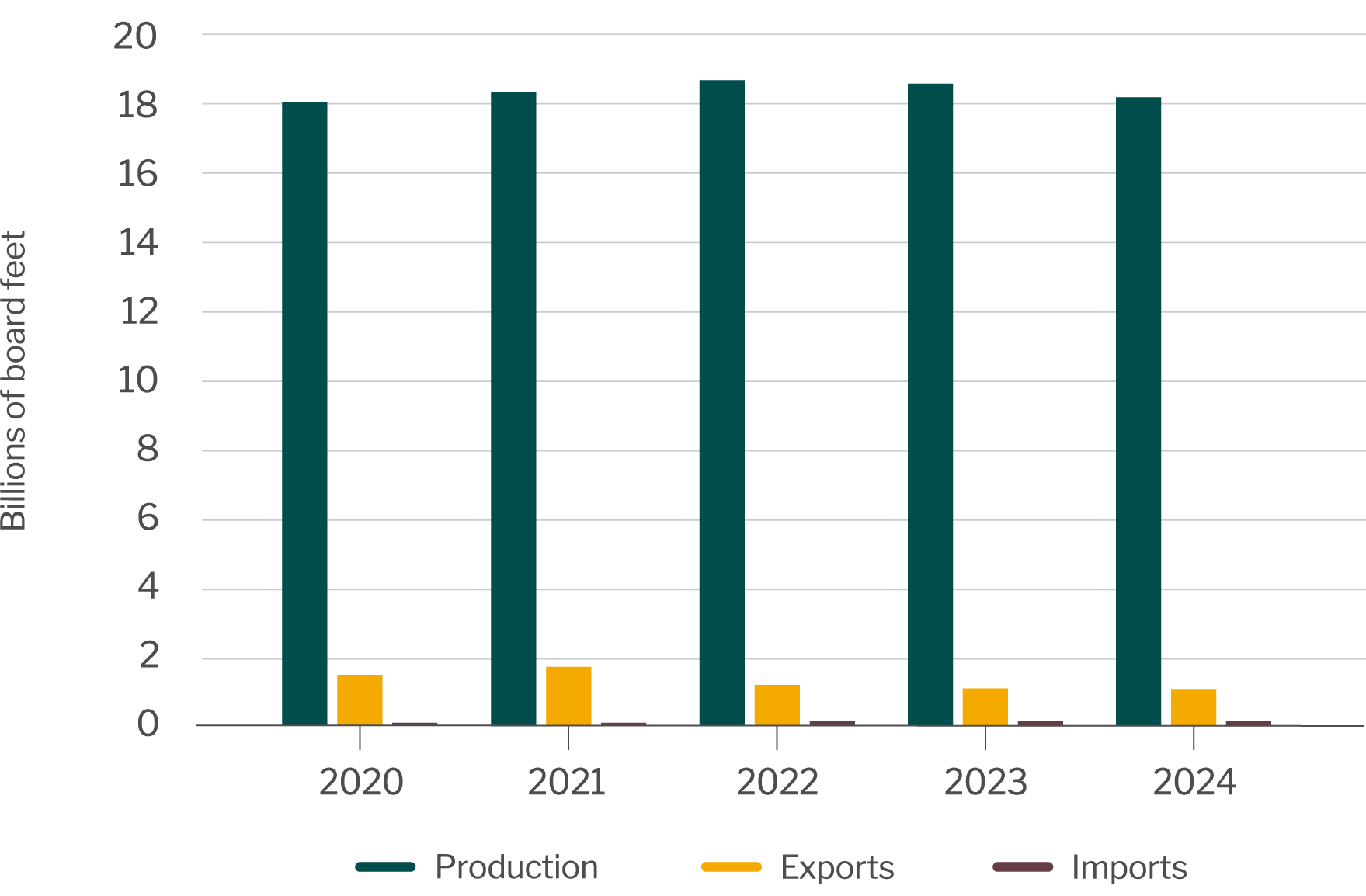
Forisk. U.S. Census Bureau. Production levels were calculated using region specific recovery rates. Trade data was converted using .22 thousand board feet per cubic meter.
Lumber production, exports and imports
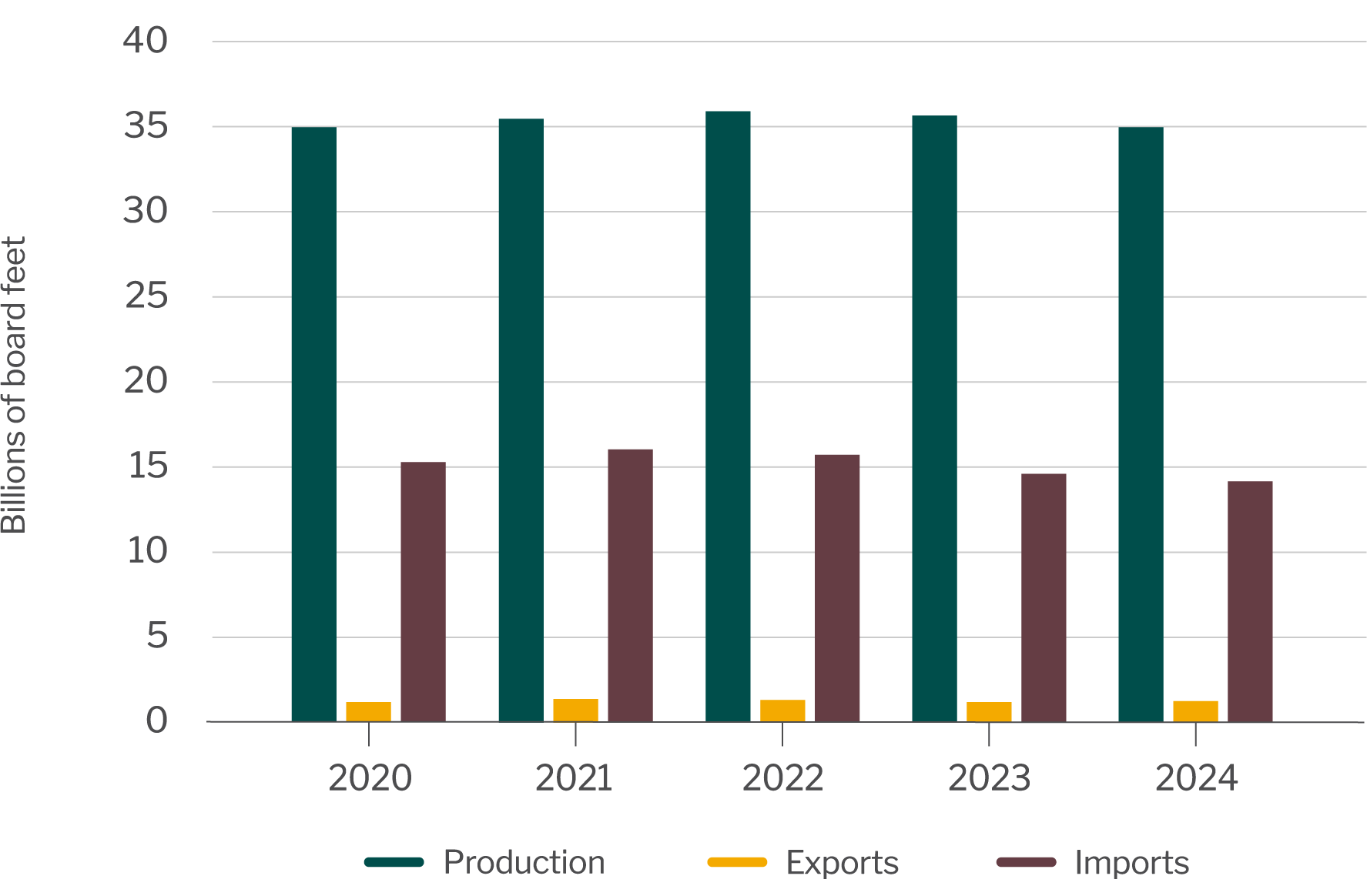
Forisk. U.S. Census Bureau. Trade data was converted using .452 thousand board feet per cubic meter.
Tariff tracker - Tariff rates applied to U.S. trade partners are consistenly updated to reflect policy changes. The World Trade Organization (WTO) tracks duties and tariffs on forest products. For your convenience, the following links will take you to tariff data for top markets, including Japan and Vietnam. Logs are currently exempt from tariffs for Canada under the United States-Mexico-Canada Agreement (USMCA), but please refer to the U.S. Trade Representative website for up-to-date information. The U.S. applies countervailing duties on Canadian lumber imports based on an annual review process (detailed information can be found at the Federal Register). Please consult with a trade lawyer or professional for detailed and up-to-date insights on tariff rates and their application to forest products.
For guidance on interpreting duty and tariff rates, please refer to our Tariff Guide.
Forest product updates
Forest products markets were flat in September.
Lumber prices held relatively flat in September as falling production levels in the U.S. helped offset weak demand. While single family home starts increased modestly in August, the homebuilder sentiment index declined to 32 in September as elevated mortgage rates, rising construction costs, labor shortages, and weak buyer traffic continued to weigh on residential construction activity (the 10-year average is 57). Housing affordability remains the industry’s primary challenge and this is unlikely to change with the average 30-Year fixed mortgage rate back above 7%.
Log markets across Oregon and Washington remain generally stable, with most mills reporting adequate inventories and little urgency to secure additional volume. Export markets continue to weaken, particularly for Douglas-fir and hemlock, although this softness has not yet been fully reflected in the trade data. Weak pulp and chip markets remain a significant challenge following several mill curtailments and closures in British Columbia and the Pacific Northwest. Wildfire activity temporarily disrupted logging operations in parts of the region, while salvage harvesting of fire-damaged ponderosa pine in Eastern Washington could increase log supplies and place downward pressure on pine prices. Transportation costs are also becoming a greater consideration as mills adjust procurement decisions to manage rising hauling expenses.

Profitability
September 16, 2026Forest product mills: Slightly profitable - Neutral 12-month outlook
Timberlands: Slightly profitable - Neutral 12-month outlook
Stable lumber demand along with falling domestic production and Canadian imports are supporting slightly profitable conditions.
Despite strong log inventories, mill demand in the Northwest remains steady and supportive of prices.
The U.S. housing market is the primary driver of forest products demand. Log and lumber exports play a relatively minor role, making up about 6% and 3% of total domestic production, respectively. On the West Coast, log producers have historically benefited from strong Japanese demand for high-quality grades. Following the Great Recession, demand from China increased significantly to support housing construction. These trends are reversing due to aging demographics and weakening economies. The Softwood Lumber Agreement sets the terms for Canadian lumber exports to the U.S., which make up about a quarter of total domestic supply.
Log production, exports and imports
Forisk. U.S. Census Bureau. Production levels were calculated using region specific recovery rates. Trade data was converted using .22 thousand board feet per cubic meter.
Lumber production, exports and imports
Forisk. U.S. Census Bureau. Trade data was converted using .452 thousand board feet per cubic meter.
Tariff tracker - Tariff rates applied to U.S. trade partners are consistenly updated to reflect policy changes. The World Trade Organization (WTO) tracks duties and tariffs on forest products. For your convenience, the following links will take you to tariff data for top markets, including Japan and Vietnam. Logs are currently exempt from tariffs for Canada under the United States-Mexico-Canada Agreement (USMCA), but please refer to the U.S. Trade Representative website for up-to-date information. The U.S. applies countervailing duties on Canadian lumber imports based on an annual review process (detailed information can be found at the Federal Register). Please consult with a trade lawyer or professional for detailed and up-to-date insights on tariff rates and their application to forest products.
For guidance on interpreting duty and tariff rates, please refer to our Tariff Guide.
IN THIS SECTION


Forest Products Industry Perspective
View the latest AgWest Forest Products Industry Perspective
Learn more