 Weather
 Locations
 Careers
 Login
Login

Quarterly Economic Update: October 2026

Market commentary for October 6, 2026
Executive summary
The U.S. economy remains resilient despite geopolitical uncertainty, evolving trade policy, and structural shifts related to artificial intelligence investment and demographic change. Consumer spending, employment, and business investment continue to support economic growth, while higher energy prices and persistent inflation pressures remain key challenges. The Federal Reserve remains focused on returning inflation to its 2% target, contributing to expectations that interest rates may remain elevated for longer than previously anticipated. Long-term Treasury yields have risen sharply, reflecting a combination of inflation expectations, economic growth, federal borrowing, strong demand for capital, geopolitical uncertainty, and investor sentiment. While the outlook remains constructive, risks include renewed inflation pressures, tighter credit conditions, escalating geopolitical conflicts, softening labor market conditions, and growing fiscal and debt-related vulnerabilities.
Economic drivers
Monetary policy remains focused on inflation.
The Federal Reserve continues to prioritize price stability as inflation remains above its 2% target. Core Personal Consumption Expenditures (core-PCE), the Fed's preferred inflation measure, increased 3.0% year over year in August. The Fed raised policy rates by 25 basis points to a target range of 3.75% to 4.00% at its September Federal Open Market Committee meeting. Policymakers generally view economic growth, employment, and consumer spending as sufficiently resilient to withstand additional policy tightening should inflation remain elevated. Financial markets continue to anticipate a higher-for-longer interest rate environment, reflecting persistent inflation pressures, resilient economic activity, and elevated energy prices.
Long-term Treasury yields move higher amid multiple pressures.
Treasury yields have risen sharply over the past quarter, with the 10-year Treasury yield increasing from approximately 4.5% to 5.3% as of early October. Unlike short-term rates, which are closely tied to Federal Reserve policy, long-term rates reflect a broader combination of factors including inflation expectations, economic growth, supply and demand for capital, Treasury borrowing needs, geopolitical uncertainty, and investor sentiment.
Large federal deficits, increased capital demand associated with AI infrastructure investment, elevated energy prices, and shifting expectations regarding inflation and economic growth have all contributed to upward pressure on long-term yields. Higher rates increase borrowing costs for households and businesses, and may eventually weigh on investment and economic activity if sustained.
Consumer spending supports growth but remains vulnerable.
Consumer spending remains the primary driver of U.S. economic growth. Retail sales rose 1.2% in August and are up 6.0% from a year ago, supported by steady employment conditions and ongoing household spending. Some economists suggest consumers may be accelerating purchases due to expectations of future price increases, though spending growth is expected to moderate in coming months.
While overall spending remains healthy, inflation continues to disproportionally affect lower income households, where food, housing and energy account for a larger share of household budgets. Consumer resilience ultimately depends on continued employment growth, wage gains, asset values, and confidence. An equity market shock or protracted bear market could eventually reduce spending and slow economic growth through a weaker wealth effect.
Geopolitical tensions increase inflation and market risks.
The conflict involving Iran, as well as the Russia-Ukraine war, continues to disrupt global energy markets. Higher oil, gasoline, and diesel prices have increased inflation pressures, volatility across financial markets, and transportation, manufacturing, and agricultural production costs.
While the conflict has not materially expanded beyond the region, current developments suggest risks remain elevated. Continued instability in energy markets could slow progress toward lower inflation, contribute to upward pressure on interest rates, and increase uncertainty for businesses and consumers.
Risks to the Economy
- Geopolitical and energy market risks: Escalation of the conflict involving Iran or other geopolitical disruptions could further pressure energy markets, increase inflationary pressures, raise business uncertainty, and weigh on global economic growth.
- Inflation and monetary policy risks: Inflation may prove more persistent than expected due to energy costs, trade policy developments, or resilient consumer demand. In that scenario, the Federal Reserve may respond too aggressively and/or hold rates too high for too long.
- Credit and financial conditions risks: Higher interest rates and economic uncertainty could lead to tighter lending standards, weaker collateral values, reduced access to credit, and growing refinancing challenges for some borrowers.
- Consumer and labor market risks: Consumer spending remains a key source of economic strength, but rising household debt burdens, elevated prices, weaker asset values, or labor market deterioration could reduce spending and slow economic growth. Delinquencies on consumer credit cards and auto loans are trending higher.
- Fiscal and long-term interest rate risks: Large federal borrowing needs could contribute to upward pressure on Treasury yields and borrowing costs. Rising debt levels may also reduce fiscal flexibility and limit policymakers' ability to respond to future economic downturns or geopolitical shocks.
Economic data and trends
Fed updates and Treasury yields
The Fed released its latest forecast for the economy as part of its monetary policy statement on June 17. Real GDP growth projections were revised lower as consumer spending, higher inflation and gas prices offset higher tax refunds. A minor decrease in unemployment was reported as job gains keep pace with the workforce. Inflation is projected to trend higher as energy prices respond to weaker supplies due to the war in Iran. One or two rate hikes were added to the outlook in response to elevated inflation projections. These increases are projected to unwind in 2027 and 2028 as inflation trends toward the Fed’s 2.0% target.
Federal Reserve projections as of June 2026
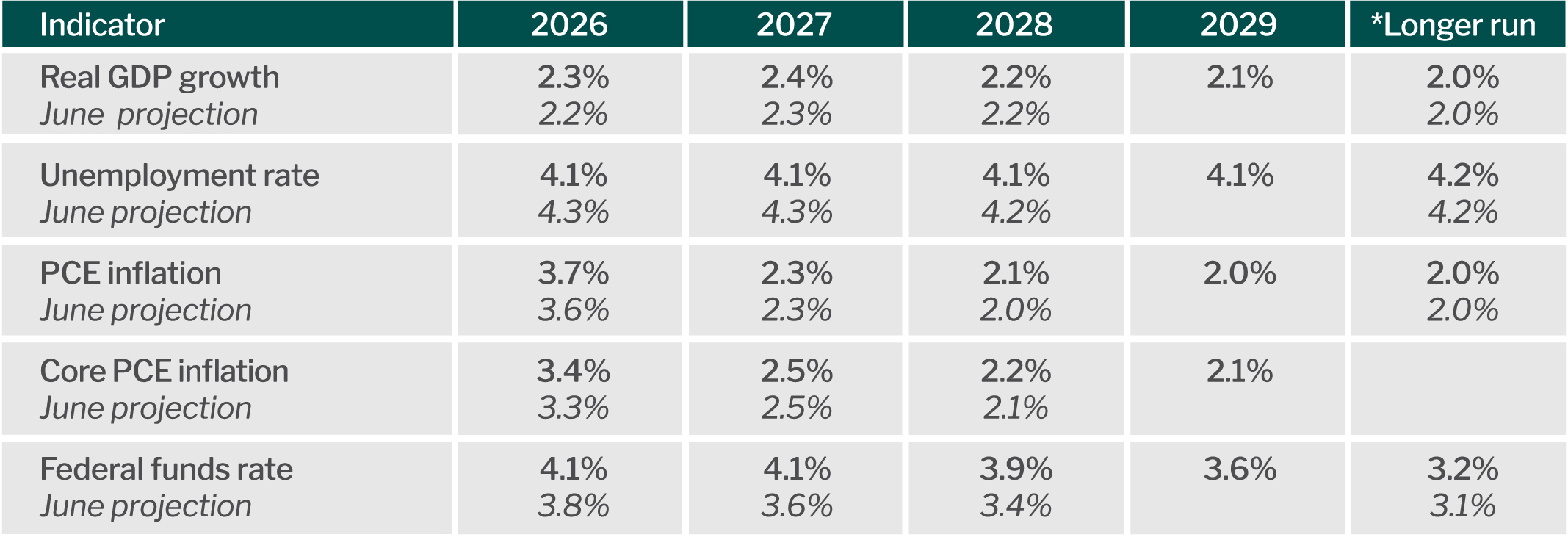
Source: Federal Reserve Board. *Longer run projections for core-PCE are not collected.
Market indications signal the 2-year Treasury yield will fluctuate in a range of 4.65-5.15% for the next couple of months while 10-year Treasury yields range between 5.3-5.6%. This outlook could change dramatically due to developments in the Middle East and other risks to the outlook.
Employment
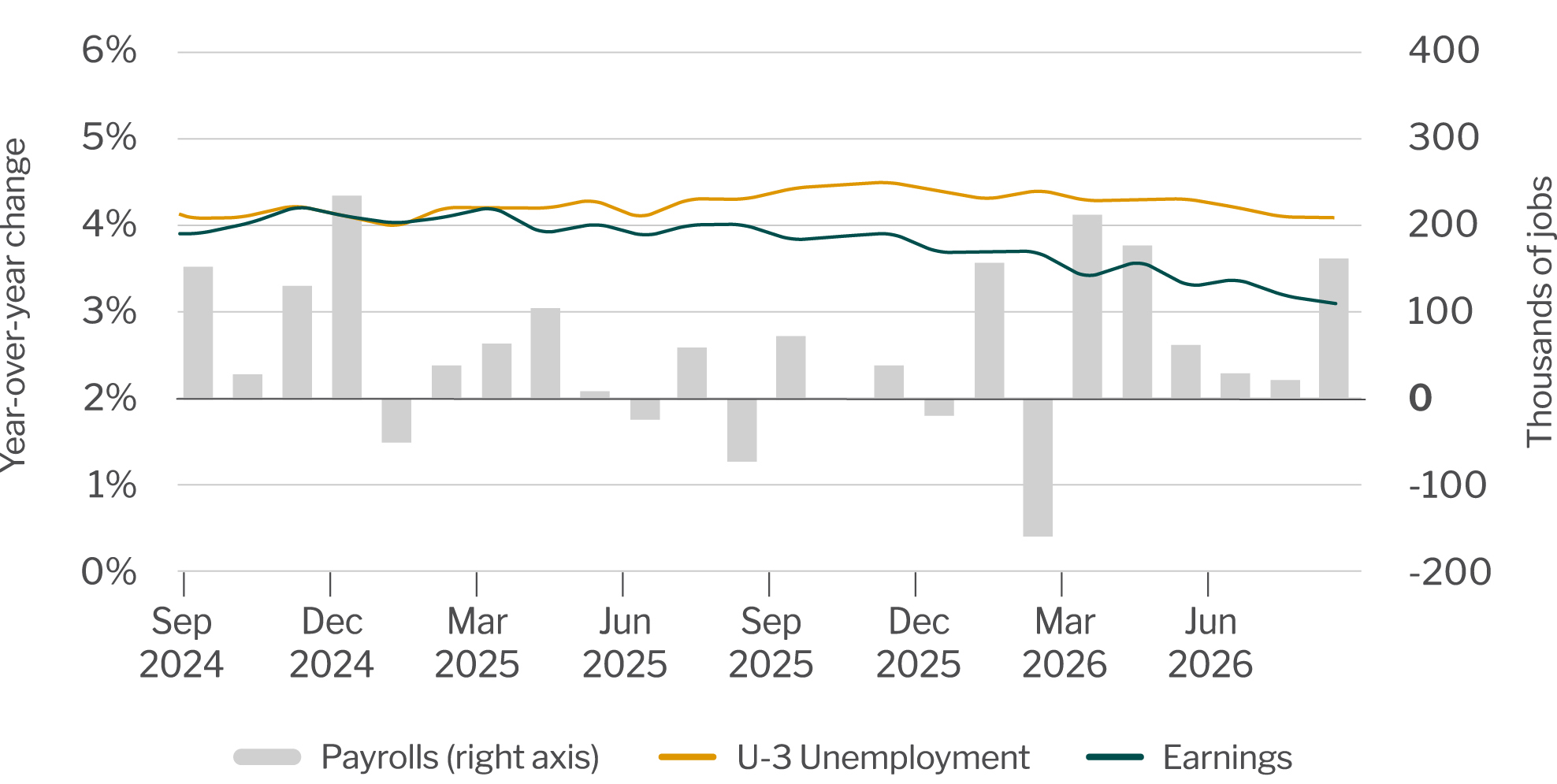
Despite payrolls employment data for September being a little softer than expected and a slight uptick in the unemployment rate, the data suggest there are few signs of labor market stress. Hiring was weaker than projected as September payrolls increased by 29,000 versus the 90,000 expected. The prior two months’ data were revised down by 60,000. Monthly gains have averaged 41,000 over the past year, which is near the break-even number of jobs required to sustain the unemployment rate at a level sufficient to support stable and moderate consumer spending.
Unemployment edged higher to 4.2% from 4.1% as labor force growth outpaced employment growth. A year ago, the jobless rate was 4.4%. Wages grew modestly, up 0.1% compared to the prior month and 3.0% year over year.
Compared to a year ago, both the labor force and the number of employed declined. Unemployment has not increased due to the decline in the labor force exceeding the decrease in employment. Despite the unemployment rate staying relatively low, the decline in the labor force is a concern over the long-term as it may limit domestic demand and economic growth.
Jobs, Unemployment and Hourly Earnings
Source: U.S. Bureau of Economic Analysis.
Inflation
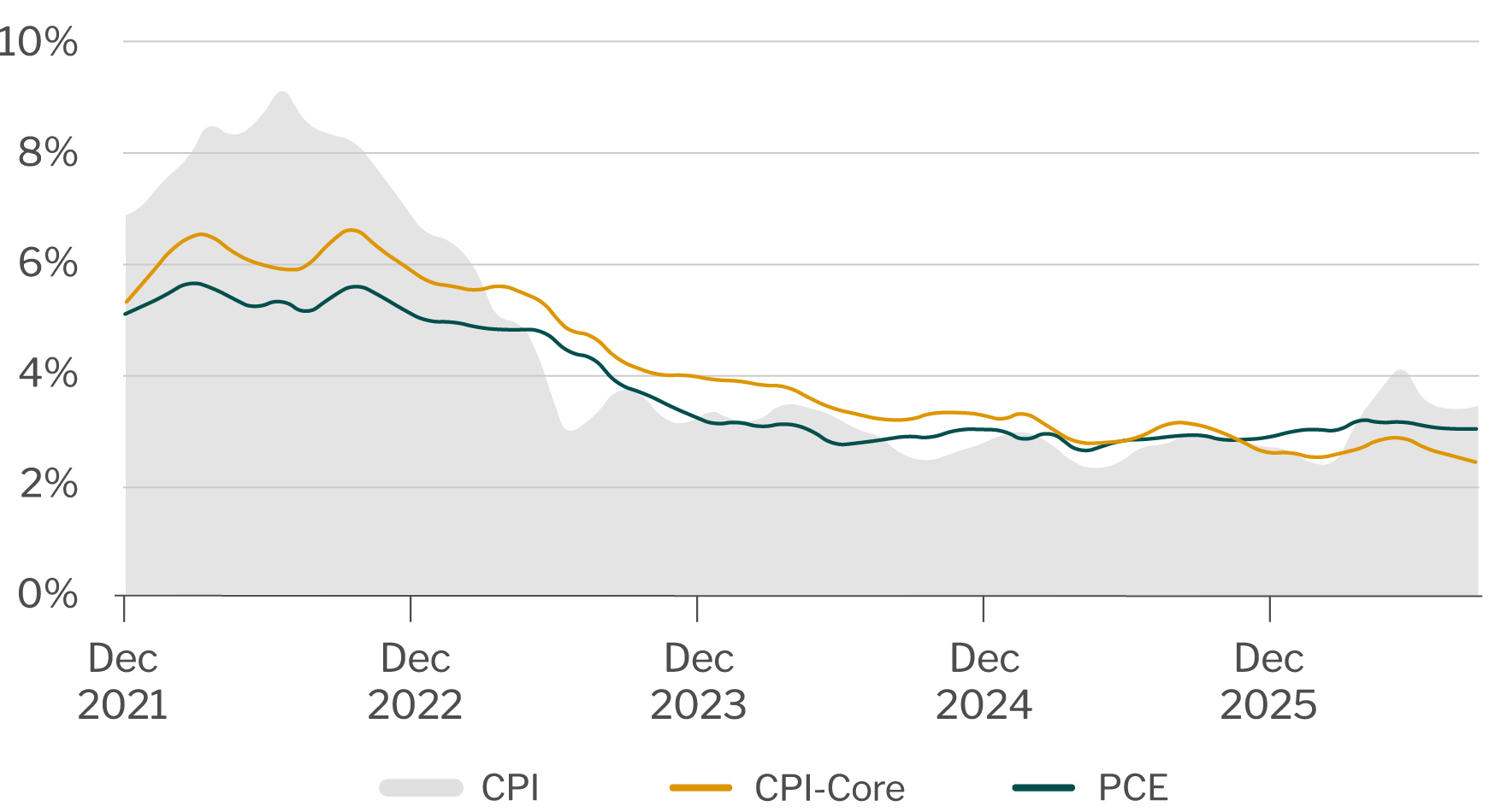
Inflation remains elevated, primarily due to higher fuel prices. Food and non-energy commodity inflation remains limited.
Consumer prices rose 0.4% in August, up from 0.1% in July, while annual inflation held at 3.4%. Gasoline prices drove much of the increase, rising 3.9% for the month and 27.4% year over year, while food and other non-energy goods saw more modest increases.
Core Consumer Price Index (CPI), which excludes food and energy, rose 0.3% monthly, but its annual growth eased to 2.4% from 2.5%.
Key sources of inflation include:
- Oil, fuel and fertilizer prices fed through the supply chain
- Tariff pass-through and trade uncertainty
- Seasonality and services inflation
- Structural forces such as deglobalization and supply chain realignment
Core-PCE inflation, the Fed’s preferred measure, rose on a year ago basis of 3.0% for June, July and August. Differences between CPI and PCE reflect differences in composition, weighting and market dynamics.
Consumer Inflation
Source: U.S. Bureau of Labor Statistics. U.S. Bureau of Economic Analysis.
Gross Domestic Product
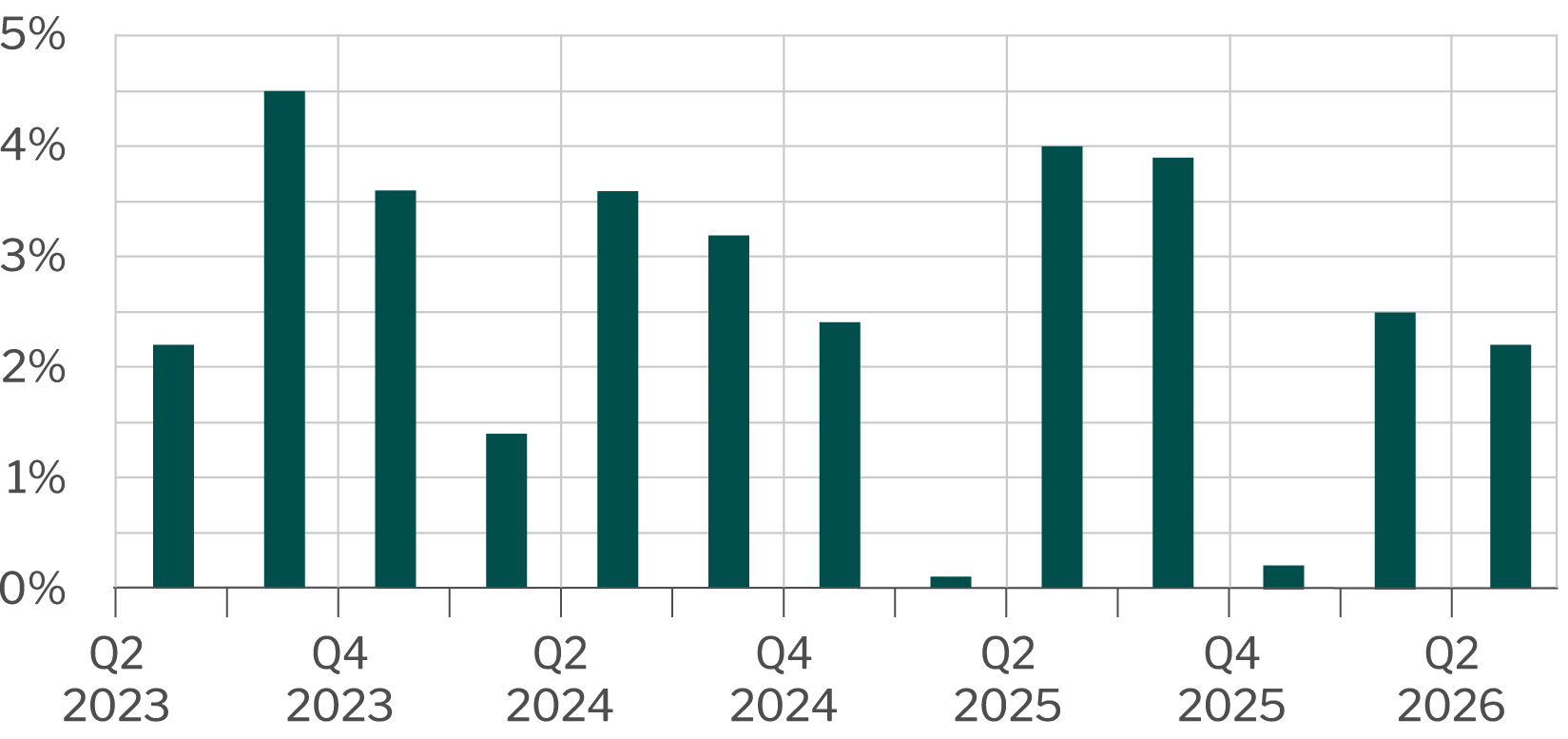
Stronger consumer spending and domestic investment continued to support growth while government spending and net exports continued to weigh on growth. Nominal GDP grew at an 8.5% rate, with the annualized GDP price index at 5.6% and the core-PCE price index at 3.3%. The third estimate for real second quarter GDP growth was revised up to 2.2% from 1.5% on stronger consumer spending and annual revisions made by the Bureau of Economic Analysis. Q1 GDP growth was revised up 0.4 percentage points to 2.5%.
Growth could accelerate to roughly 3% in Q3, with forecasts ranging from 2.5% to 3.7%. Consensus forecasts put annual growth at 2.2% for both 2026 and 2027, slightly below Federal Reserve projections. Modest growth is projected to be supported by continued wage growth and service sector strength. Economic activity is being constrained by higher interest rates, excessive consumer and fiscal debt, and geopolitical uncertainty. The probability of recession within the next 12 months is estimated at approximately 20%, reflecting modest downside risk.
Gross Domestic Product (GDP)
Source: U.S. Bureau of Economic Analysis.
Return to Customer Stories home page.